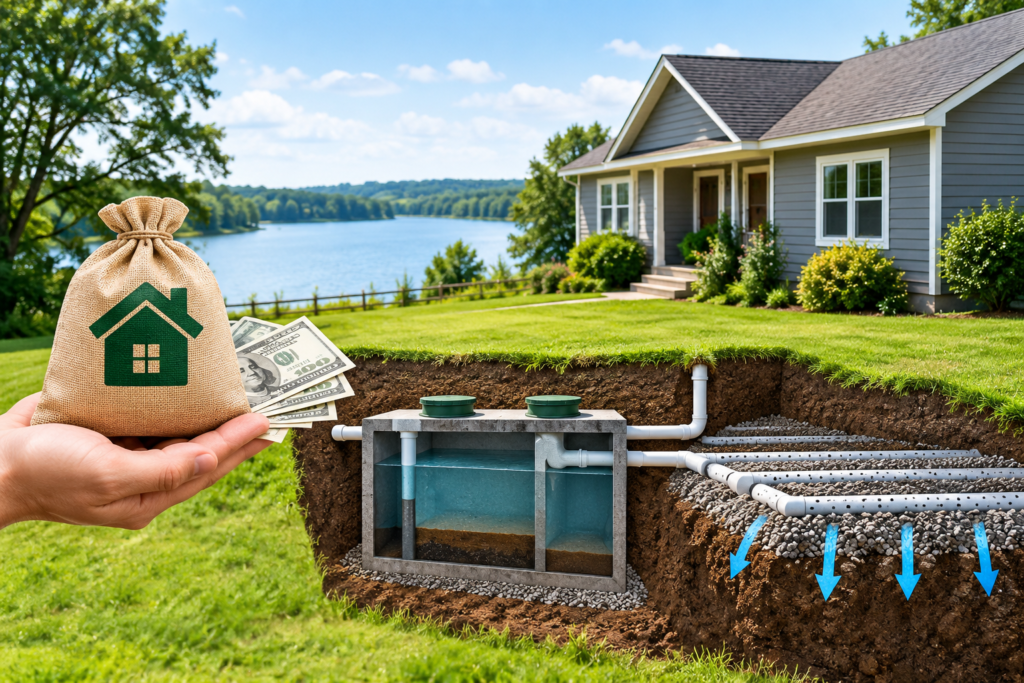



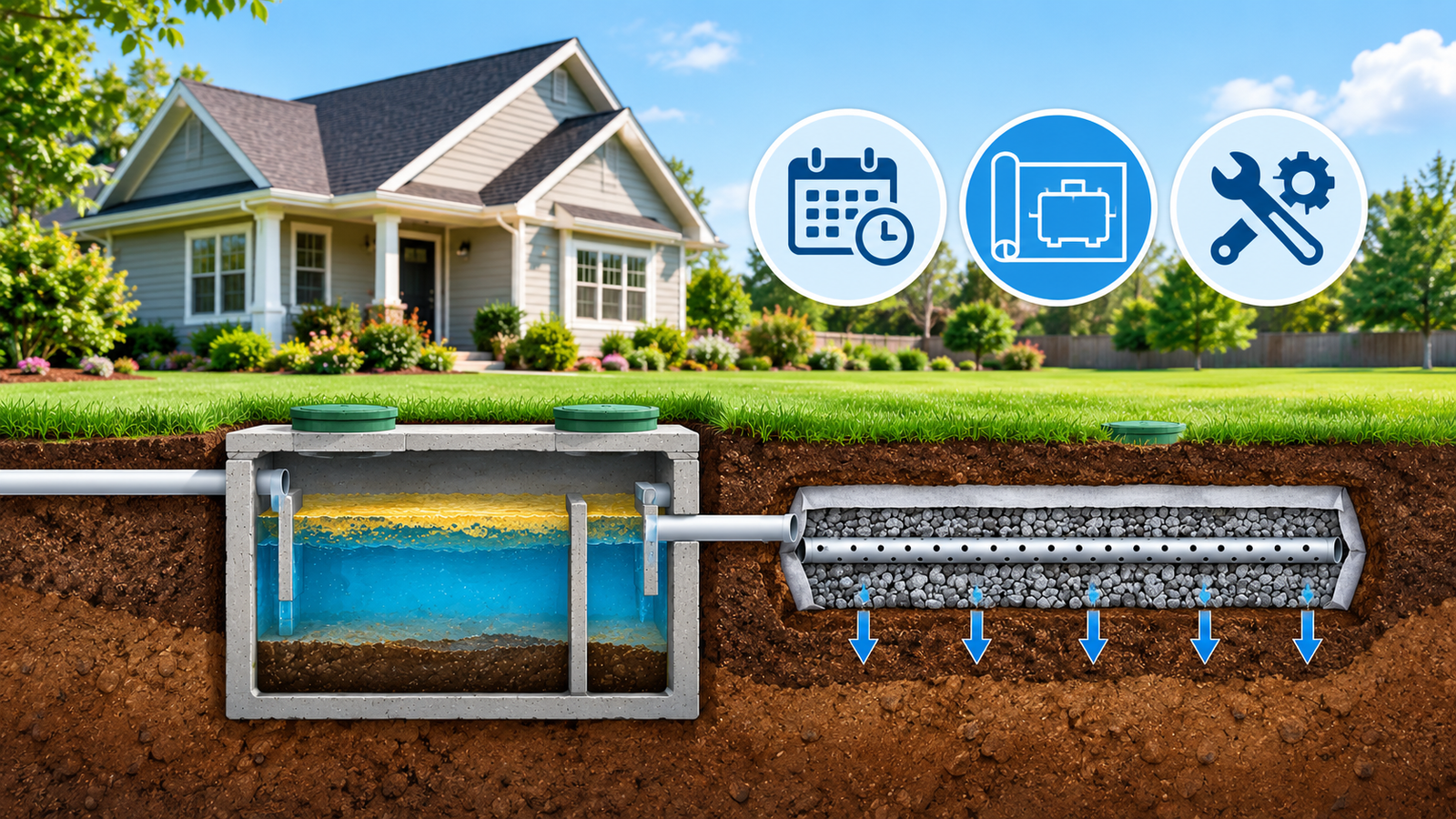
About one in five American households isn’t connected to a city sewer line. If that’s you, the tank buried in your yard is quietly doing one of the most important jobs on your property: treating every gallon of water that leaves your sinks, showers, washing machine, and toilets before it goes back into the ground.
Most people never think about it. That’s the problem. A septic system stays invisible right up until the morning your shower won’t drain or a soggy patch appears over the leach field. By then you’re looking at an emergency call and, in bad cases, a five-figure repair.
The good news is that these systems are not mysterious. Once you understand what each part does and what wears it out, you can predict roughly how much life you have left and stretch it by decades. This guide walks through septic system design, realistic lifespan numbers for every component, why drain fields fail, and the maintenance habits that actually matter.
| What you’re asking about | Realistic lifespan |
| The system as a whole | 25 to 40 years |
| Concrete septic tank | 40 to 100+ years |
| Plastic (HDPE) tank | 30 to 50 years |
| Fiberglass tank | 30 to 40 years |
| Drain field / leach field | 15 to 30 years |
| Effluent or grinder pump | 10 to 15 years |
The tank is almost never what kills a system. The soil under your drain field is. A concrete tank can outlive the house it serves, while the field beside it may need replacing two or three times over the same period.
How a Septic System Actually Works
Think of it as a small, private wastewater treatment plant that runs on gravity and bacteria instead of electricity and chemicals.
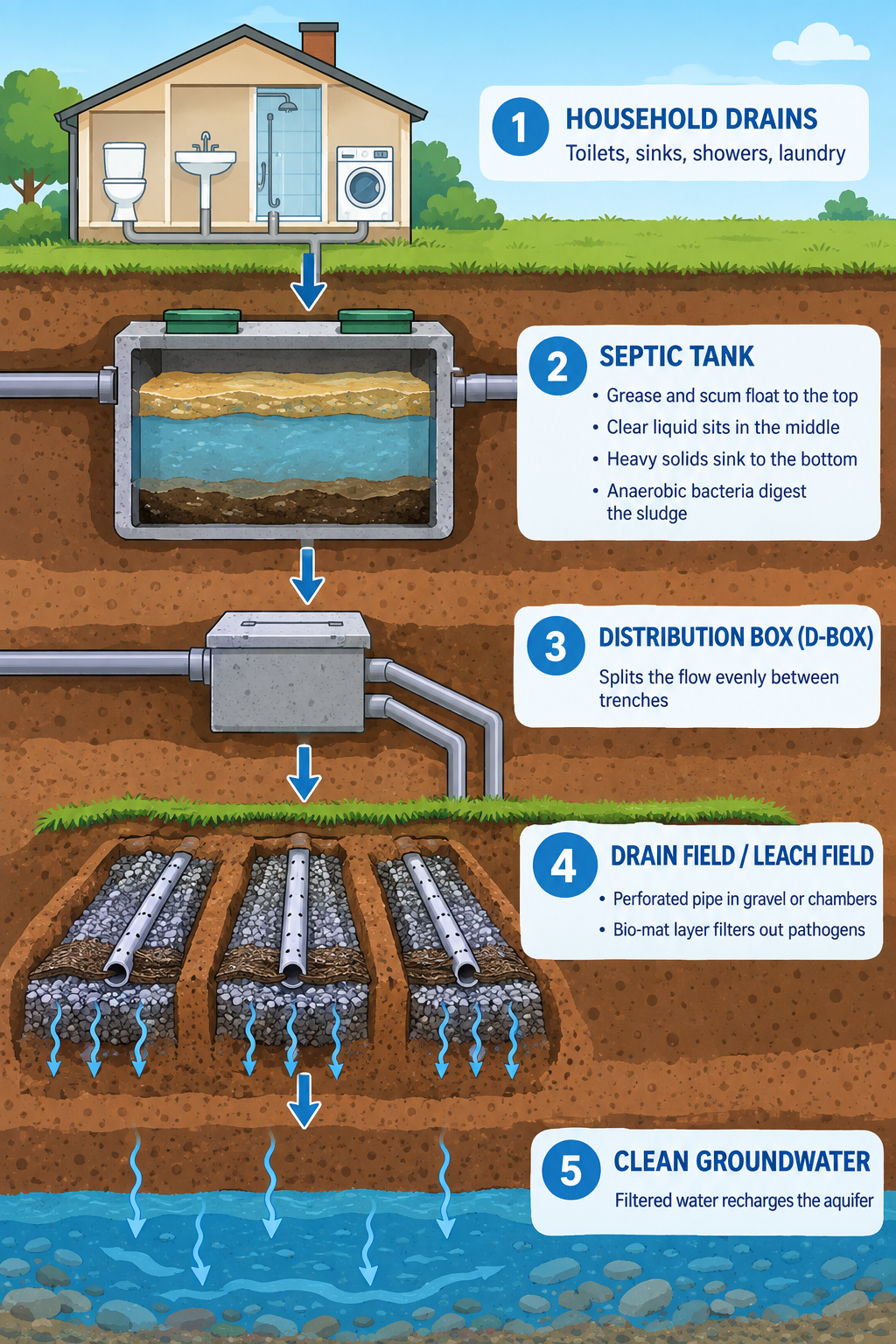
- The building drain: The main pipe running from your house to the tank. It needs a consistent slope of about a quarter inch per foot. Too flat and solids settle in the pipe. Too steep and the water races ahead, leaving the solids behind. Either way you get clogs.
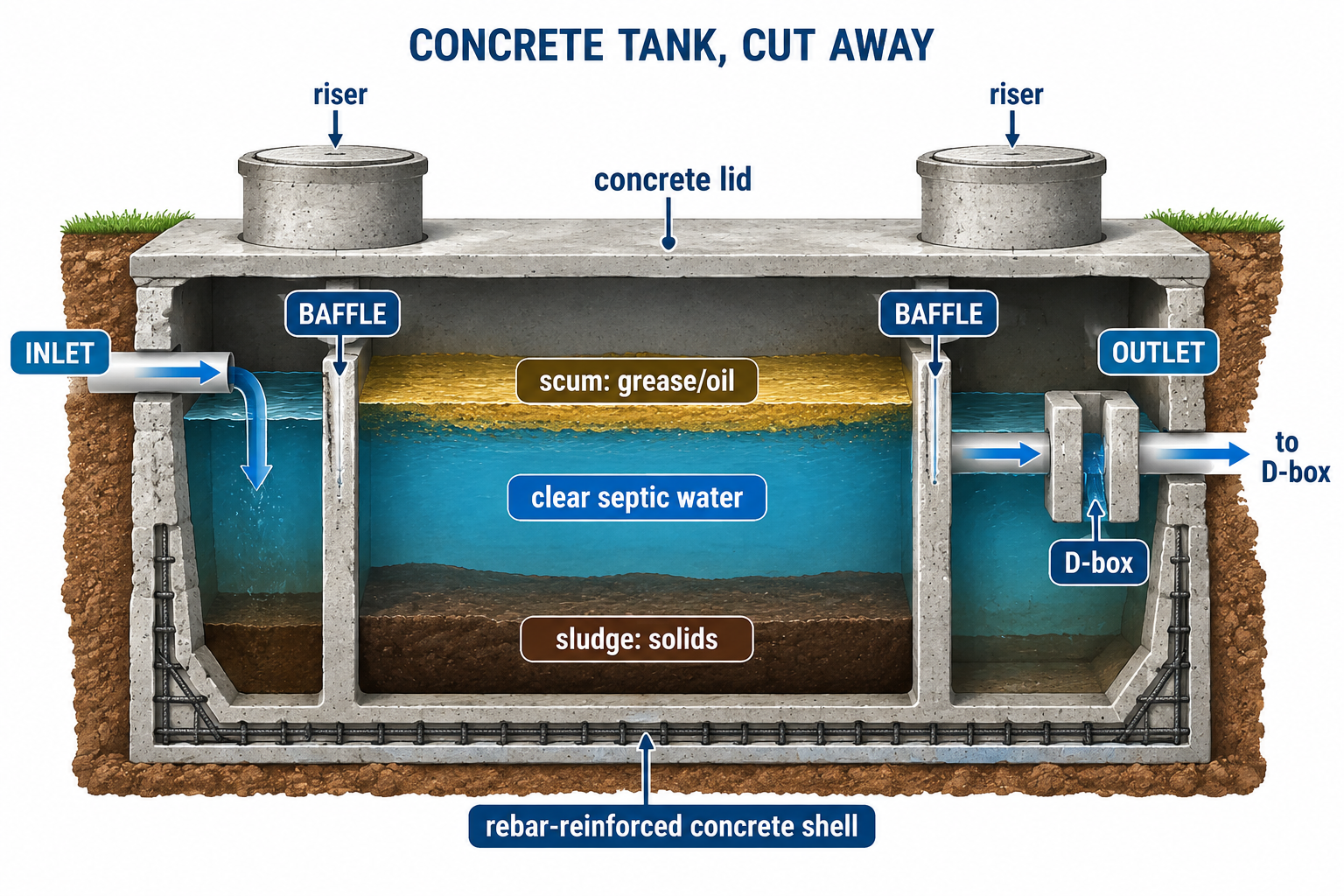
- The tank: A watertight box, usually a 1000 gallon concrete septic tank on a typical three-bedroom home, though plastic and fiberglass are common too. Its only job is to slow the water down long enough for gravity to sort it into three layers: scum on top, clear septic water in the middle, sludge on the bottom.
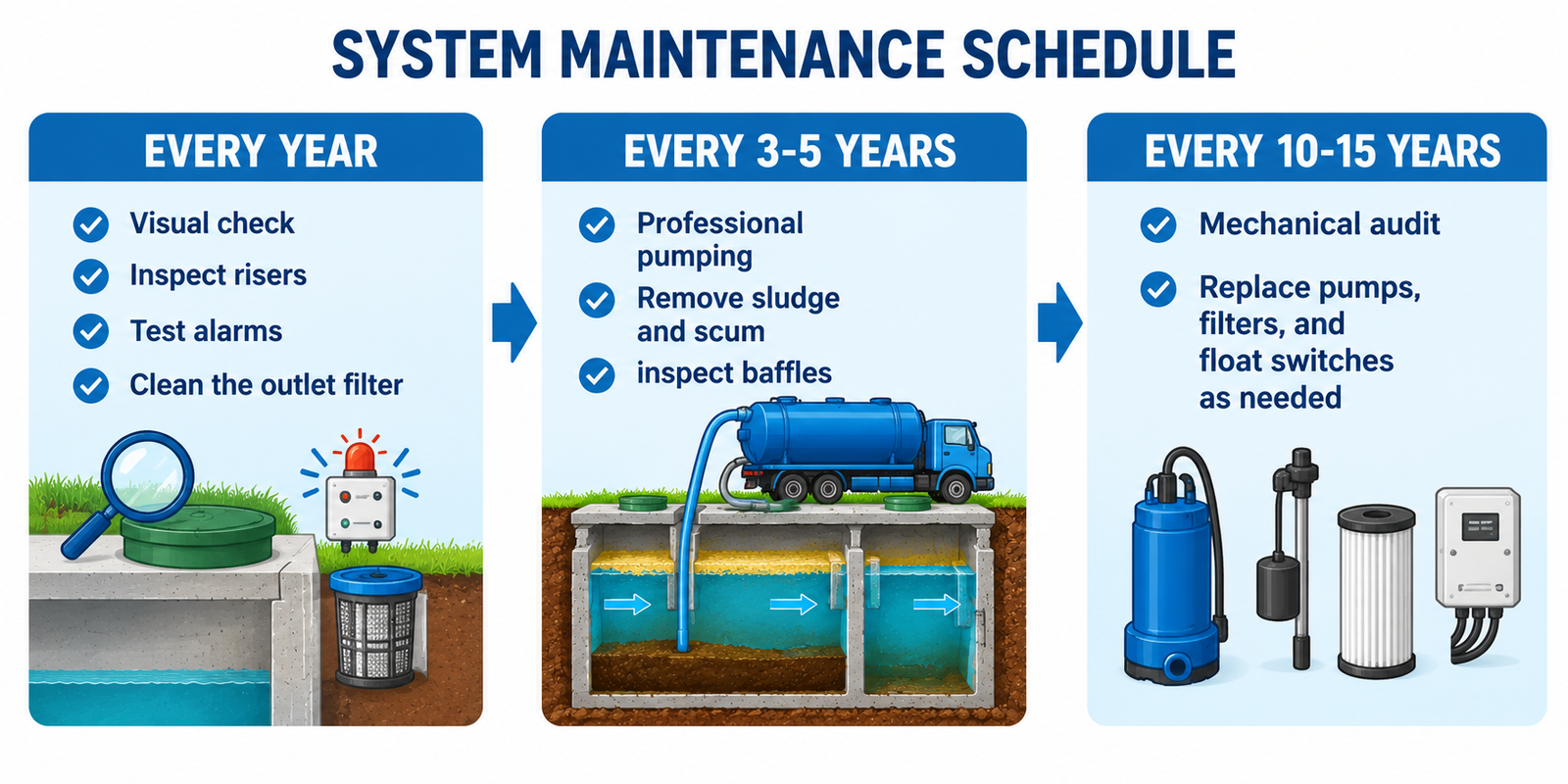
- Baffles and the outlet filter: Baffles at the inlet and outlet keep floating grease and settled sludge from sneaking out toward the drain field. The outlet filter is a cheap screen that catches fine solids. Cleaning it once a year is one of the highest-value chores in this entire guide.
- The distribution box: A small concrete or plastic junction that splits the outgoing flow evenly across the trenches. When a D-box tilts because the soil settled, one trench takes most of the load and fails years early.
- The drain field: A grid of perforated leach field pipe laid in gravel trenches or plastic chambers, buried in unsaturated soil. This is where treatment actually finishes. The soil, not the tank, is what removes pathogens.
Septic System Lifespan Chart
Here’s how the numbers break down component by component, along with what kills each one and what it looks like when it’s dying.
| Component | Typical lifespan | What wears it out | Warning signs |
| Concrete tank | 40–100+ years | Acidic soil, hydrogen sulfide corrosion above the waterline, settling, vehicles driving overhead | Cracked walls, collapsed baffles, groundwater seeping in |
| Plastic / polyethylene tank | 30–50 years | High water table pushing it up, improper backfill, crushing | Bowed walls, split seams, tank shifting or floating |
| Fiberglass tank | 30–40 years | Soil movement, seal failure at joints | Cracks along the seams, warping under heavy backfill |
| Perforated PVC field pipe | 25–40 years | Tree roots, compaction, crushing from surface traffic | Wet patches, sewage smell over the field, slow drains |
| Drain field soil | 15–30 years | Hydraulic overload, bio-mat clogging, clay smearing during install, harsh chemicals | Standing water over the trenches, backups indoors |
| Effluent or grinder pump | 10–15 years | Failed float switches, short cycling, running dry, power surges | High-water alarm, pump running constantly, tripped breaker |
| Distribution box | 15–25 years | Acidic effluent eating the concrete, uneven settling | One trench soggy while others stay dry |
Two systems installed the same week on the same street can differ by twenty years, depending entirely on soil type, household size, and whether anyone bothered to pump the tank.
Concrete vs. Plastic vs. Fiberglass Tanks
When you start browsing septic tanks for sale, the first real decision is material. Everything else follows from it.
Concrete: the default for a reason
A high-density concrete tank usually lasts 40 years and often well past 100. It’s the heaviest option and the most forgiving.
The weight is the whole advantage. A 1000 gallon concrete septic tank runs somewhere between 8,000 and 12,000 pounds empty. Water tables don’t move it. Pumping it dry doesn’t move it. It just sits there.
The weakness shows up slowly. As bacteria digest waste inside the tank, they release hydrogen sulfide gas. That gas reacts with moisture on the dry upper walls and turns into sulfuric acid, which eats concrete from the inside out. It’s gradual, usually showing real damage somewhere in the 30 to 50 year range, and it hits the baffles and the underside of the lid first. This is exactly why an inspector looks at the top third of the tank, not the bottom.
Plastic and polyethylene: light, tough, and floaty
High-density polyethylene units are rated for 30 to 50 years and they have one clear edge over concrete: nothing corrodes them. Acidic soil doesn’t care. Sulfuric gas doesn’t care. Rust isn’t a concept.
The tradeoff is weight. An empty plastic tank might weigh 400 to 1,000 pounds, which is roughly nothing when there’s groundwater underneath it. If a plastic tank isn’t anchored properly and the pumper empties it during a wet spring, it can behave like an upside-down boat and lift right out of the ground. Backfill matters too. Dump heavy soil against one side without balancing it and the walls bow inward.
Plastic septic tanks are a strong choice on tight sites, on properties with difficult access, and anywhere a crane and a 6-ton concrete pour aren’t realistic.
Fiberglass: the middle ground
Fiberglass sits at 30 to 40 years. It’s light like plastic and rigid like concrete, but it’s more brittle than either. Seam bonds and joint seals are the usual failure points, and it doesn’t tolerate careless backfilling.
Why Drain Fields Fail (and Why It’s Always the Field)
This is the part homeowners underestimate, so it’s worth understanding.
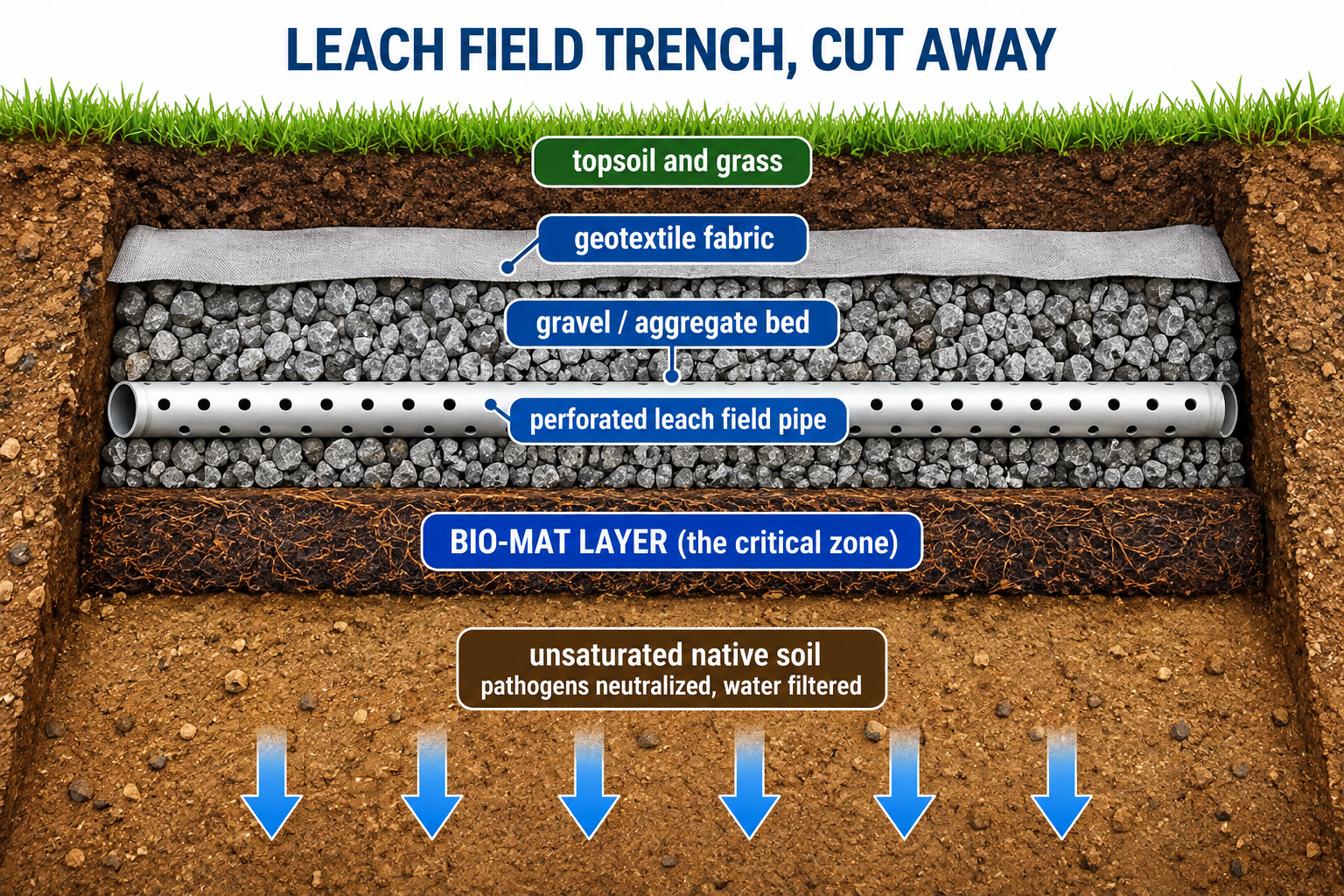
When liquid leaves the tank, it trickles through the gravel and hits the native soil. At that boundary, bacteria colonize the surface and form a dark, slimy layer called the bio-mat. That layer is not a defect. It’s the actual filter.
Years 1 to 5. The bio-mat forms and starts doing its job, trapping pathogens before they can reach groundwater.
Years 5 to 20. Equilibrium. The mat is thick enough to filter and thin enough to let water pass at a steady rate. This is a healthy field.
Years 20 and beyond. If solids have been escaping the tank because nobody pumped it, the mat keeps thickening. Soil pores seal off. Water can no longer percolate down, so it goes sideways and up. That’s when you see effluent surfacing on the lawn or backing into the basement.
Once a field is truly clogged, there’s no additive, enzyme, or miracle powder that reverses it. You rest it if you can, or you replace it. Which is why every maintenance recommendation below is really about protecting the soil.
Pump Systems, Mound Systems, and Other Engineered Setups
Not every lot works with simple gravity. Shallow bedrock, a high water table, or a drain field uphill from the house all call for a pump.
Mound systems
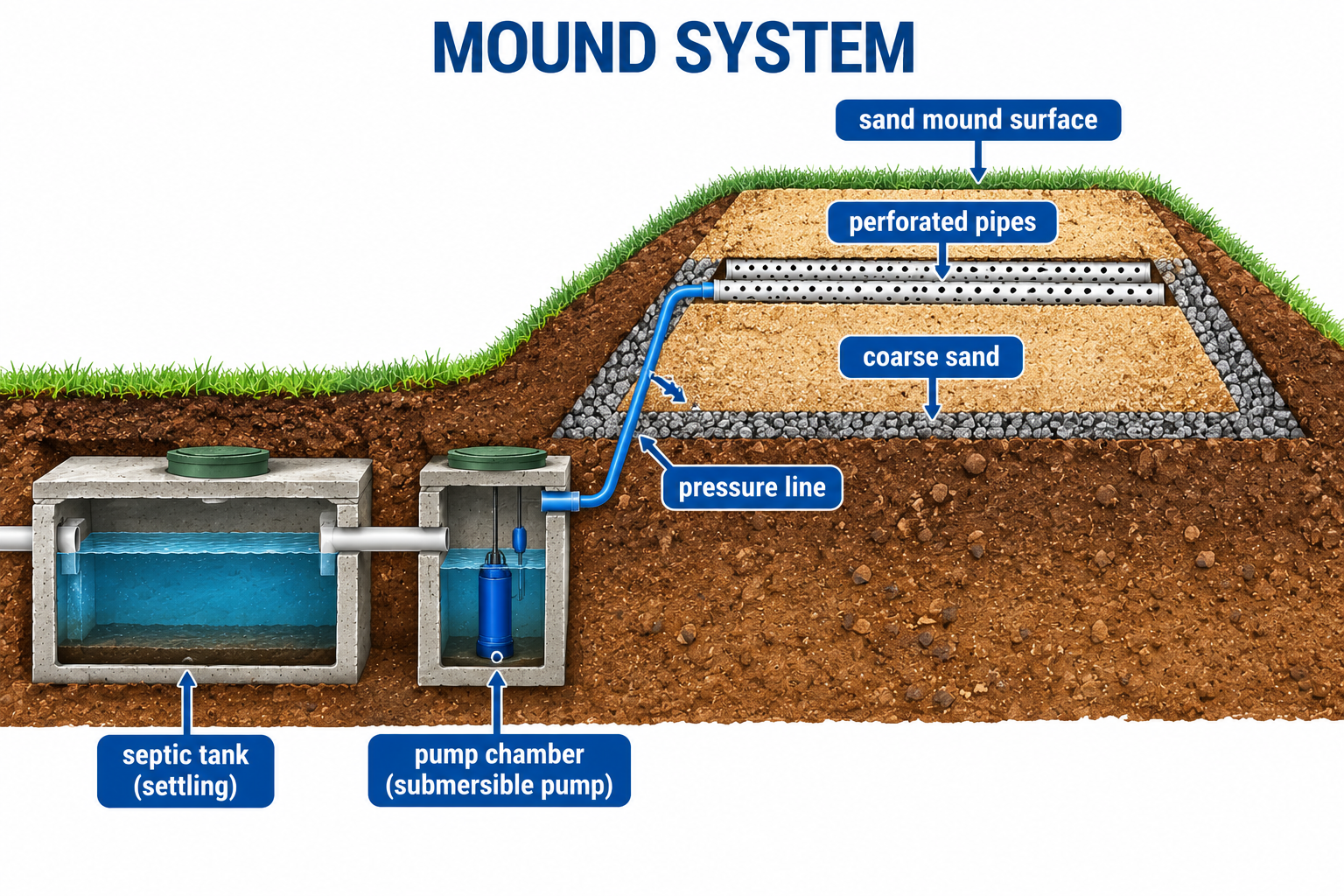
When there isn’t enough soil depth to safely filter wastewater, a mound septic design raises the drain field above the original grade. Effluent flows into a pump chamber, and a pump pushes it up into a bed of engineered sand and gravel built on top of the ground.
Expect the sand bed to last 20 to 25 years. The pump serving it typically needs replacement every 10 to 12 years, since it works harder than a standard effluent pump.
Pumps and float switches
Submersible effluent and grinder pumps under normal residential load run 10 to 15 years.
The float switch usually dies first. A float that sticks in the “on” position makes the pump run dry, and a dry pump can burn out its motor in a matter of hours. A float stuck “off” means the chamber fills until the alarm sounds, or until it doesn’t.
Sizing matters just as much. Undersize the pump for the vertical lift and it overheats. Oversize it and it short cycles, killing the start capacitor. If your alarm goes off, don’t just reset the breaker and walk away. Something changed.
Warning Signs You Shouldn’t Ignore
Call a professional if you notice any of these:
- Drains throughout the house slowing down at the same time
- Gurgling from toilets or tubs when the washer drains
- Grass over the drain field that’s suddenly greener or spongier than the rest of the yard
- Standing water or a sewage smell over the trenches
- The high-water alarm sounding, even intermittently
- Backups that happen after heavy rain or a big laundry day
- Well water tests showing elevated nitrates or coliform bacteria
A single slow drain is a plumbing problem. All of them at once is a system problem.
Maintenance That Actually Extends Lifespan
Pump on a schedule, not on a hunch
Skipping pumping is the single biggest cause of early drain field failure. As sludge piles up, there’s less liquid volume in the tank, which means less time for solids to settle, which means solids ride out to the field and choke the bio-mat. The tank damage is reversible. The field damage isn’t.
| Household size | Pumping interval |
| 1–2 people | Every 4–5 years |
| 3–4 people | Every 3 years |
| 5 or more people | Every 1–2 years |
Add a garbage disposal, a home business, or frequent guests and shorten the interval.
Protect the soil’s water limit
Hydraulic overloading means more water is entering the system than the soil can absorb.
- Spread laundry across the week instead of running six loads on Saturday.
- Route gutters, sump pump discharge, and driveway runoff away from the drain field.
- Fix running toilets fast. One can waste hundreds of gallons a day straight into your field.
- Install low-flow fixtures if your system is older or your soil is heavy clay.
Protect the soil’s structure and biology
- Never drive or park over the field. Vehicles compact the soil, crush pipe, and crack lids. Don’t build a shed or patio there either.
- Keep harsh chemicals out. Drain cleaners, solvents, motor oil, oil-based paint, and heavy bleach kill the bacteria doing the digestion.
- Flush waste and toilet paper only. Wipes labeled “flushable” are not. Neither are paper towels, dental floss, cat litter, hygiene products, coffee grounds, or grease.
- Watch your landscaping. Grass over the field is ideal. Trees and shrubs send roots straight into the pipes.
Keep the paperwork
Save your as-built diagram, permits, and pumping receipts. In many states an inspection is required before you can sell the house, and knowing exactly where the tank and trenches sit saves hours of probing. Some states, Massachusetts among them, have formal point-of-sale inspection requirements.
Repair, Replacement, and What It Costs
Costs vary a lot by region, soil, and local permitting, but ballpark figures in the US look like this:
| Job | Typical range |
| Routine pumping | $300–$700 |
| Outlet filter replacement | $50–$300 |
| Effluent pump replacement | $800–$2,500 |
| Distribution box repair | $500–$2,000 |
| New tank only | $3,000–$8,000 |
| New drain field | $5,000–$20,000 |
| Full system replacement | $10,000–$30,000+ |
| Mound or engineered system | $15,000–$50,000+ |
Timing is worth knowing too. Replacing just the tank is usually a one- to three-day job once permits are in hand. A full system replacement runs one to two weeks of work, but the permitting and soil evaluation ahead of it can add several weeks to a few months depending on your county health department. Start early if you know a replacement is coming.
Terminology, Regional Names, and Common Misspellings
Search for this stuff online and you’ll run into a lot of variation, both real terminology and typos. Here’s what’s what.
Regional and international terms
- Fosa séptica / fossa séptica / tanques septicos — Spanish and Portuguese terms for multi-chamber settling tanks.
- Fosse septique — the standard French term for a residential wastewater tank.
- Fosa septică / fossa septica — Romanian and Italian terminology for the same thing.
- Safety tank — a term used in parts of South Asia for what Americans call a septic tank.
- Cesspool tank / septic pit — older single-pit installations. Unlike a modern watertight tank paired with a drain field, a septic pit or cesspool lets untreated liquid seep straight out through perforated sidewalls into the surrounding soil. They’re banned for new construction across most of North America, though existing ones still turn up during real estate transactions.
Common misspellings
You’ll see these in search bars and forum posts, but avoid them when you’re looking up building codes, permits, or manufacturer specs, since official documents won’t match:
spectic tank, spectic system, septic tanl, septoc tanks, septum tank, seotic tank, septic.tank, sepetic tank, septic tsnk, sebtic tank, septic tann, sepitic tank, septic syste, sceptic tanks, septic tnak, subtic tank, speptic tank, septic tabk, spetic tank, saptic tank, septiv tank, swptic tank, septic thank, septi tank, septic septic, septics, and the social tag #septictank.
The correct spelling is septic, from the Greek word for putrefaction. “Sceptic” is a doubter. Different word entirely.
Frequently Asked Questions
How long does a septic system last?
A well-maintained system lasts 25 to 40 years, and the average lifespan of a septic system in the US lands right around 30. Some go far longer. The tank is rarely the limiting factor; the drain field is.
How long do septic tanks last?
It depends on material. Concrete runs 40 to 100+ years, plastic 30 to 50, and fiberglass 30 to 40. Steel tanks, which you still find on older properties, rust through in 15 to 30 years and are considered end-of-life the moment they’re found.
How long do concrete septic tanks last?
Concrete septic tank lifespan is typically 40 years minimum, with many reaching 75 to 100 years or more. Corrosion from hydrogen sulfide above the waterline is the usual cause of eventual failure, not the concrete itself giving out.
How long do plastic septic tanks last?
Plan on 30 to 50 years. Plastic won’t corrode, but installation quality determines everything. A properly anchored, properly backfilled HDPE tank hits the top of that range.
How long does a drain field last?
Most drain fields last 15 to 30 years, with 20 to 25 being typical in decent soil. Sandy loam gives you the long end. Heavy clay and high water tables give you the short end.
How long should a leach field last?
Same numbers as above, since it’s the same thing under a different name: 15 to 30 years. If yours failed at 12, the cause is almost always hydraulic overload, missed pumping, or a poor original site evaluation.
How long does a septic pump last?
Effluent and grinder pumps last 10 to 15 years. The float switch usually goes first, often within 5 to 10 years, and replacing it is a fraction of the cost of a new pump.
Can a septic system last 50 years?
Yes. A concrete tank in well-draining sandy loam, pumped every three years, serving a modest household, will comfortably reach 50 years without structural replacement. It may still need a new drain field somewhere in that span.
Can a septic system last 100 years?
The tank can. The drain field almost certainly won’t. Soil eventually saturates with fine particles and organic bio-mat, and no amount of care prevents that forever. A 100-year-old property on septic is typically on its second or third field even if the original concrete tank is still in service.
How long does it take to replace a septic tank?
Excavation and installation usually take one to three days. The bigger variable is permitting and inspection, which can add anywhere from two weeks to a few months depending on your county.
Do septic tank additives extend lifespan?
No credible evidence supports that. A healthy tank already has all the bacteria it needs. Some additives are actively harmful, since they can suspend solids that were supposed to settle and push them out into the field.
What’s the fastest way to shorten a system’s life?
Skip pumping, run all your laundry on one day, park a truck over the field, and pour bleach down the drain. Any one of those is enough. All four together will take a 30-year system down to 10.
The Bottom Line
Life expectancy of a septic tank is measured in decades, and the difference between 20 years and 50 years comes down to a handful of habits: pump on schedule, clean the outlet filter, keep water and vehicles off the field, and take alarms seriously.
The tank in your yard is one of the most durable things you own. The soil around it is one of the most fragile. Protect the soil, and the system takes care of itself.