


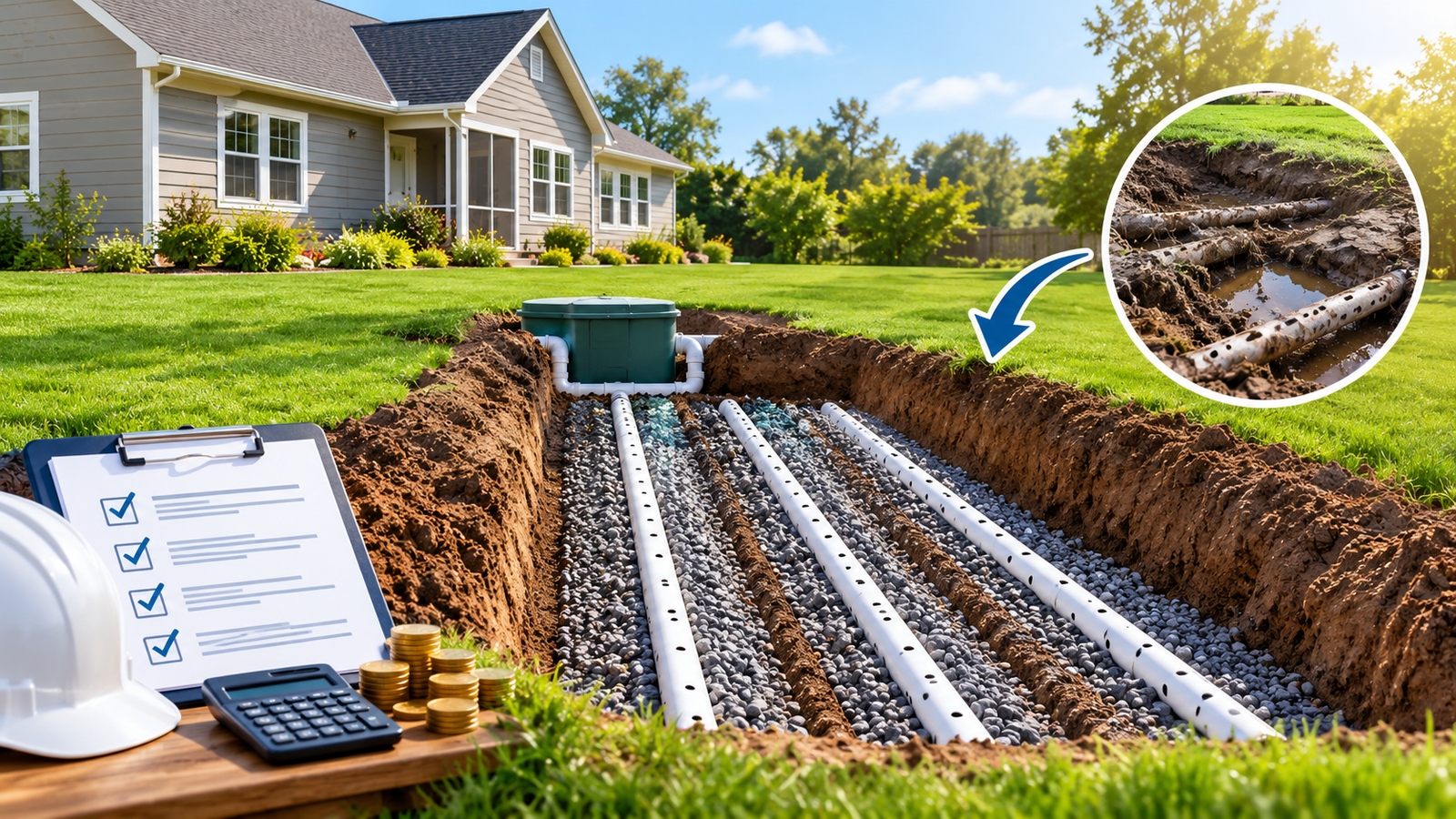
Your yard is soggy, your drains are slow, and someone just said the words “drain field.” Here’s what that means, what it costs, and how to avoid paying for a replacement you may not need.
If you’re reading this because something has gone wrong, here are the four things that matter most.
1. Get it diagnosed before you agree to anything.
A camera inspection costs $200 to $500. A full replacement costs $5,000 to $20,000. Any contractor who quotes you a replacement without looking inside the pipes first has skipped a step. That’s a red flag, not a shortcut.
2. It might be fixable.
Not every soggy yard needs a new drain field. A broken distribution box is a few hundred dollars. A clogged filter is less. Repairs and cleaning run $1,000 to $5,000 — a fraction of replacement.
3. If it does need replacing, expect $5,000 to $20,000.
Most homeowners land between $10,000 and $15,000. If your soil is bad and you need a mound system, budget $15,000 to $25,000.
4. Your soil decides the price, not you.
This is the hard part to accept. A soil test at the new location determines what kind of system you’re allowed to install. Good soil means a cheap system. Clay or rock means an expensive one. No amount of shopping around changes that.
What Is a Drain Field, Anyway?
Let’s start with what actually happens under your yard, because everything else makes more sense afterward.
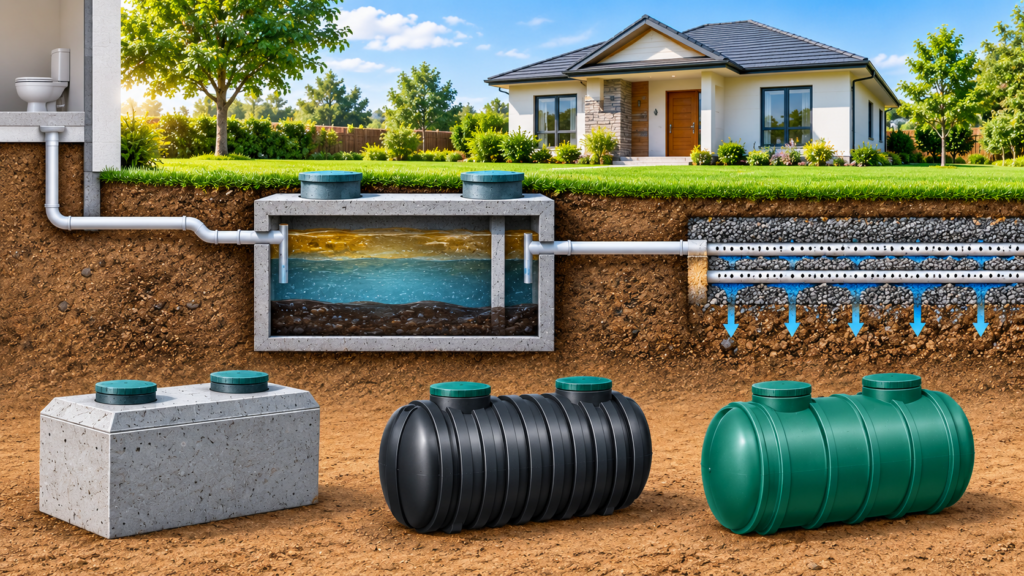
Everything you flush or pour down a drain goes into your septic tank. Inside the tank, heavy solids sink to the bottom. Grease and light material float on top. The fairly clear liquid in the middle — called effluent — flows out the far end of the tank.
That liquid goes to your drain field. It has other names: leach field, septic bed, absorption field, or just “the field.” They all mean the same thing — a set of buried perforated pipes, usually laid in gravel-filled trenches, spread across part of your yard.
The liquid seeps out of those pipes and soaks slowly down through the soil. The soil is the real filter. Bacteria in it finish cleaning the water before it reaches the groundwater below.
Two things follow from that, and they explain almost every septic problem:
- Your tank’s only real job is keeping solids out of the field. When solids escape, the field clogs.
- When the field clogs, the water has nowhere to go. It backs up — into your yard, or into your house.
That’s why the drain field is the expensive part. The tank can be swapped out. The drain field depends on the soil around it, and once that soil is ruined, you can’t unruin it.
What It All Costs
Quick cost overview
| What you need | Typical cost |
|---|---|
| Camera inspection to diagnose the problem | $200 – $500 |
| Cleaning out the pipes (hydro-jetting) | $400 – $1,500 |
| Replacing the distribution box | $300 – $1,500 |
| Repairing tank baffles and adding a filter | $300 – $900 |
| Soil rejuvenation (air fracturing) | $1,000 – $3,000 |
| Repairs and rejuvenation overall | $1,000 – $5,000 |
| Standard drain field replacement | $5,000 – $20,000 |
| Mound system (bad soil) | $15,000 – $25,000 |
| Tank and drain field together | $8,000 – $25,000 |
| Moving the field somewhere else | $5,500 – $21,500 |
A note on these numbers: the national average for a conventional replacement in 2026 sits around $10,000 to $12,000. Prices have risen noticeably in the last couple of years, so older cost guides you find online will likely under-quote you. Costs also vary by region — the Southeast tends to run near average, but Florida’s high water table means many properties need mound systems, pushing totals to $15,000–$25,000 even where labor is cheap.
Where the money actually goes
| Cost item | Typical range | Why it matters |
|---|---|---|
| Soil test (perc test) | $500 – $2,000 | Decides whether you get a cheap system or an expensive one |
| Engineering and design | $1,000 – $3,000 | Needed for mound and other special systems |
| Permits and inspections | $450 – $2,000 | Set by your county |
| Digging and machinery | $1,500 – $5,000 | Rock, slopes and tight access all push this up |
| Materials (pipes, gravel, chambers) | $1,500 – $6,000 | Depends on how much trench you need |
| Labor | 60% or more of the total | This is the biggest line item, by a lot |
| Tree removal and clearing | $500 – $3,000 | Only if the new field area is wooded |
| Closing off the old field and regrading | $500 – $2,500 | Usually required by code |
Labor being 60%+ of the bill is worth sitting with for a moment. It means the price of pipe barely matters. What matters is how many hours the crew spends on your property — which is driven by access, soil, slope, and how much digging is needed.
Cost by the size of your house
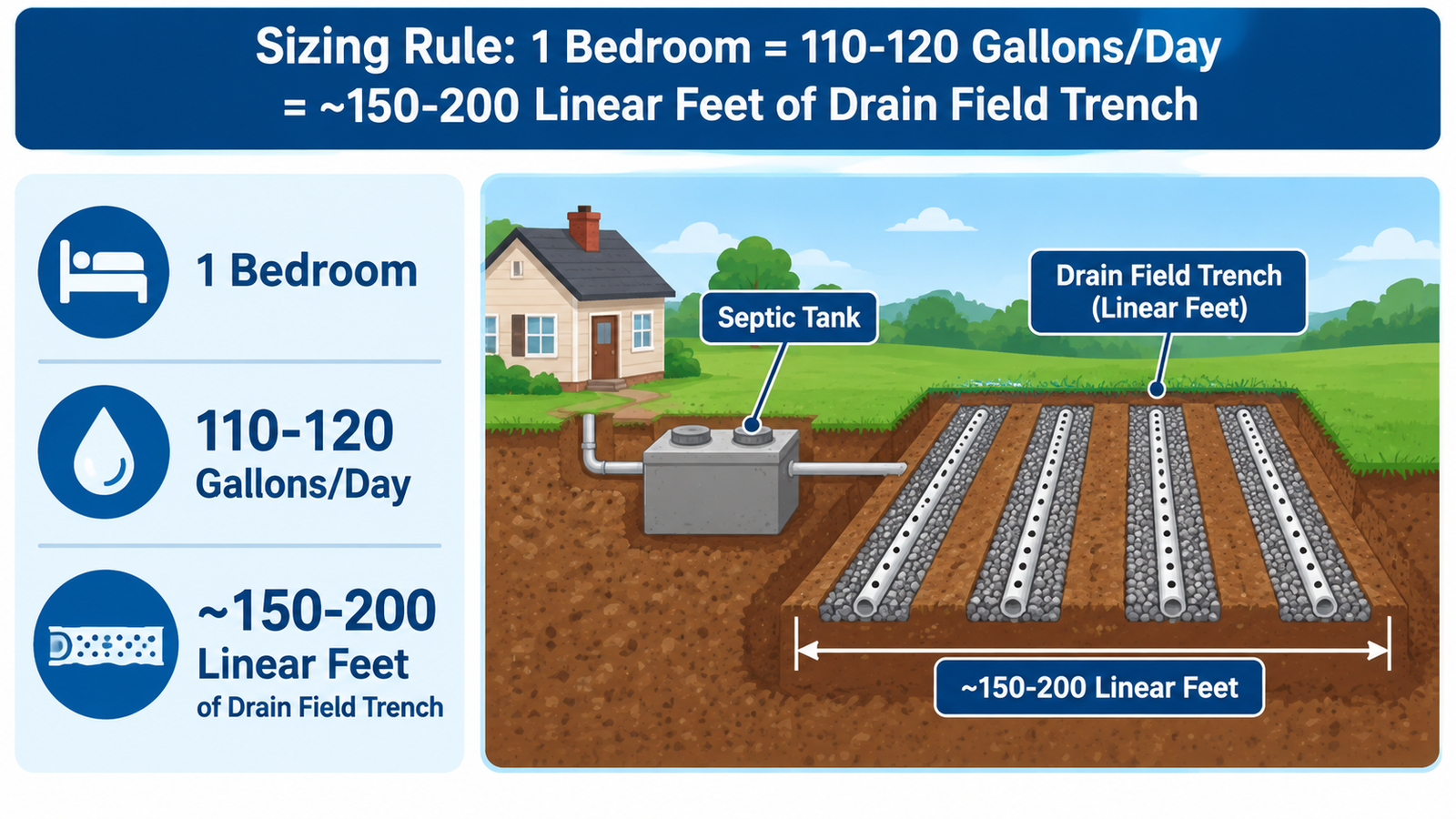
Septic systems are sized by bedroom count, not by how many people live there. Counties use bedrooms because the house might be sold to a bigger family later. Each bedroom is counted as roughly 110 to 120 gallons of water a day.
| Your home | Trench you’ll need | Typical cost |
|---|---|---|
| 1–2 bedrooms | 200–300 feet | $4,000 – $8,000 |
| 3–4 bedrooms | 300–500 feet | $7,000 – $15,000 |
| 5+ bedrooms | 600+ feet | $12,000 – $22,000+ |
The Types of Drain Field, Explained Simply
You don’t fully get to pick. Your soil test picks for you. But it helps to know what the words mean when a contractor uses them.
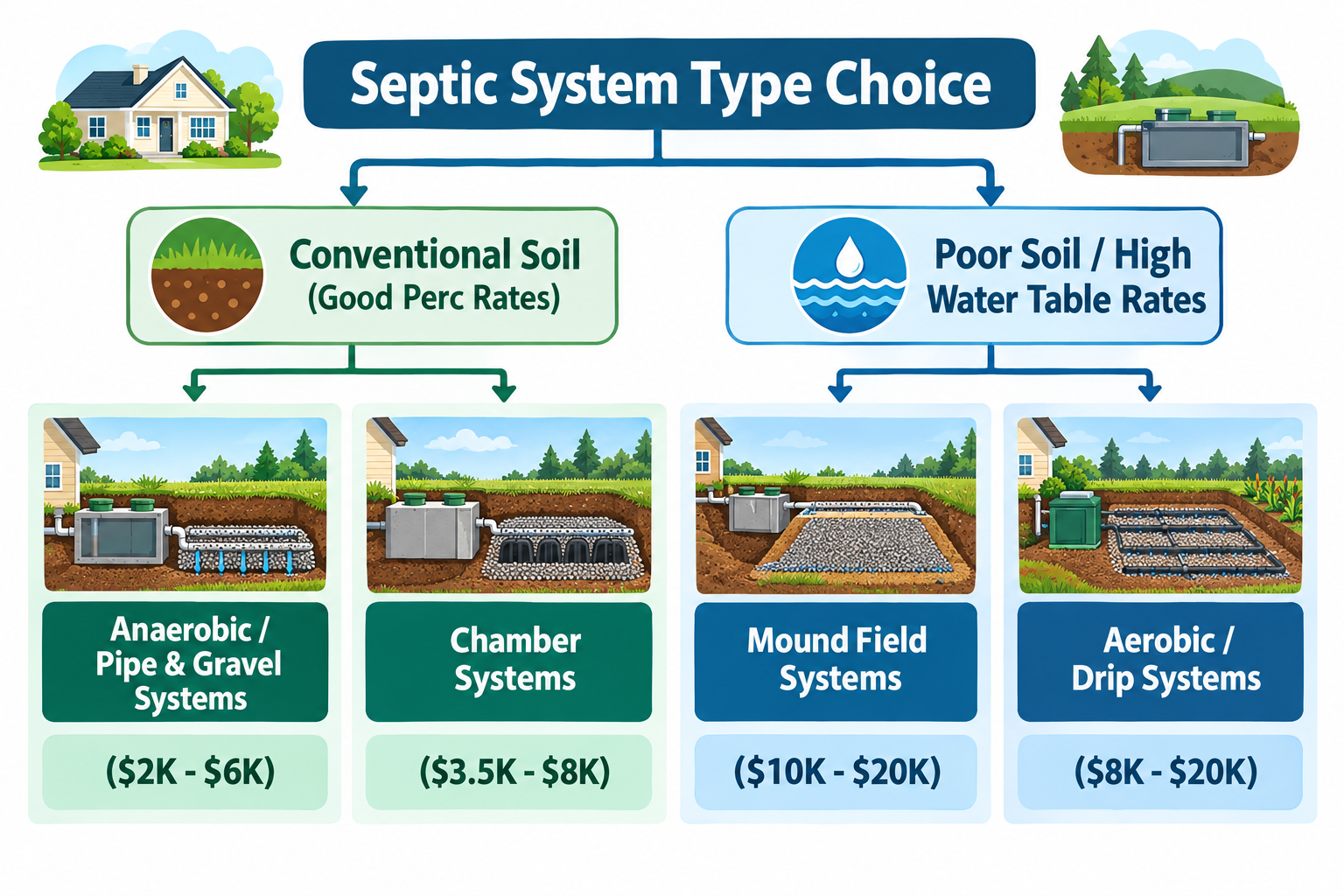
Conventional pipe-and-gravel — $5,000 to $12,000
How it works: Perforated pipes sit in gravel-filled trenches. Liquid trickles through the gravel and into the soil below. Gravity does all the work — no pumps, no electricity, no moving parts.
When you can have it: Good, deep, well-draining soil (think sandy loam) and a water table well below the trenches.
Why you want it: It’s the cheapest to install and the cheapest to own. Nothing can break because nothing moves.
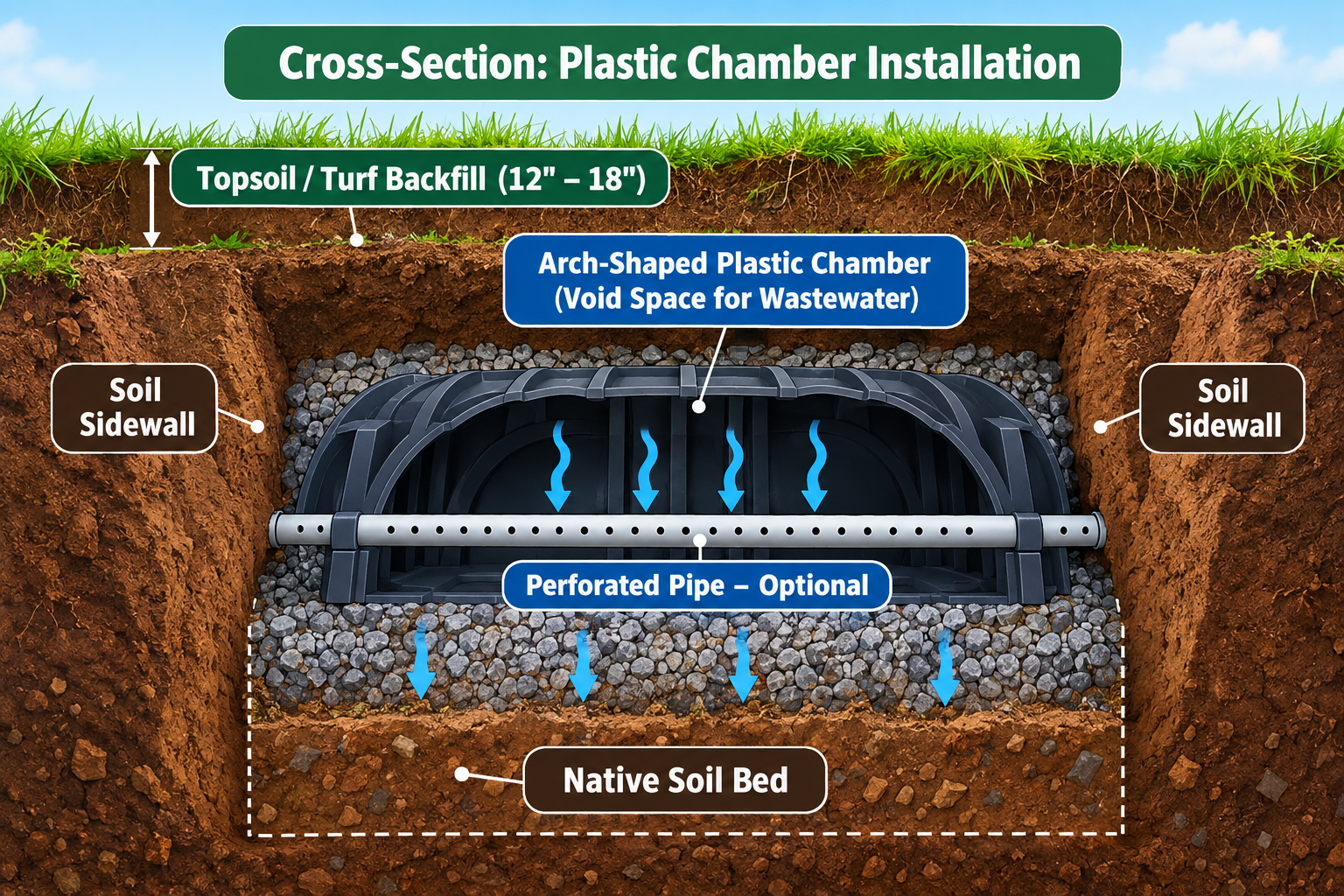
Plastic chamber systems (gravelless) — $8,000 to $18,000
How it works: Instead of gravel, arch-shaped plastic chambers sit open-side-down in the trench, creating a hollow space for the liquid.
Why contractors like them: More storage space than gravel, no gravel trucks to haul in, less digging, faster installation, and no risk of the gravel being contaminated with fine material that clogs the soil.
When you’d use one: Widely used as a normal alternative to gravel, and helpful where hauling gravel is difficult or expensive.
Aerobic treatment systems — $10,000 to $20,000 installed
How it works: An electric pump blows air into the treatment tank. Bacteria that need oxygen work faster and cleaner than the ones in a standard tank, so the liquid reaching the field is much cleaner.
When you’d need one: Small lots, environmentally sensitive areas, or when the county requires cleaner discharge.
The catch nobody mentions up front: these systems have moving parts and usually require an annual service contract of $300 to $500, plus electricity to run the pump. Factor that into your decision, because it’s a cost you’ll carry for decades.
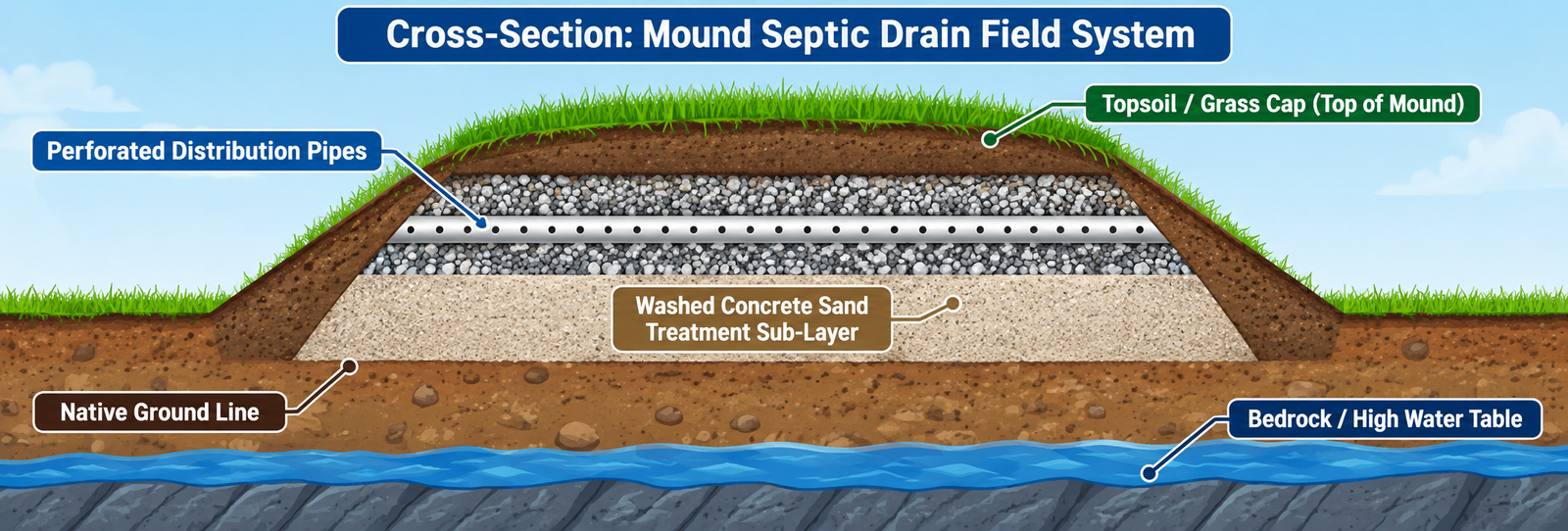
Mound systems — $15,000 to $25,000
How it works: When your natural soil can’t do the job, you build better soil above it. Clean sand is trucked in and piled above ground level, with the distribution pipes laid inside it. A pump pushes the liquid uphill into the mound.
When you’d need one: Heavy clay, shallow bedrock, or a high water table.
Why it costs so much: You’re paying to truck in 20 to 40 cubic yards of approved sand, plus a pump, plus a more complicated design. It also leaves a visible raised area in your yard, which surprises people.
Drip systems — $8,000 to $18,000
How it works: Highly filtered liquid is pumped through thin flexible tubing buried just 6 to 12 inches down, released slowly across a wide area.
When you’d need one: Steep slopes, heavily wooded lots, or shallow soil where you can’t dig deep trenches.
Evaporation systems — $8,000 to $15,000
How it works: A sealed, lined sand bed where water is drawn up through sand and plants and evaporates into the air instead of soaking into the ground.
When you’d need one: Only works in genuinely dry climates — Arizona, Nevada, west Texas. Useless in a rainy region.
How to Tell If Your Drain Field Has Failed
Catching this early is worth thousands of dollars. Early problems are repairable. Late ones aren’t.
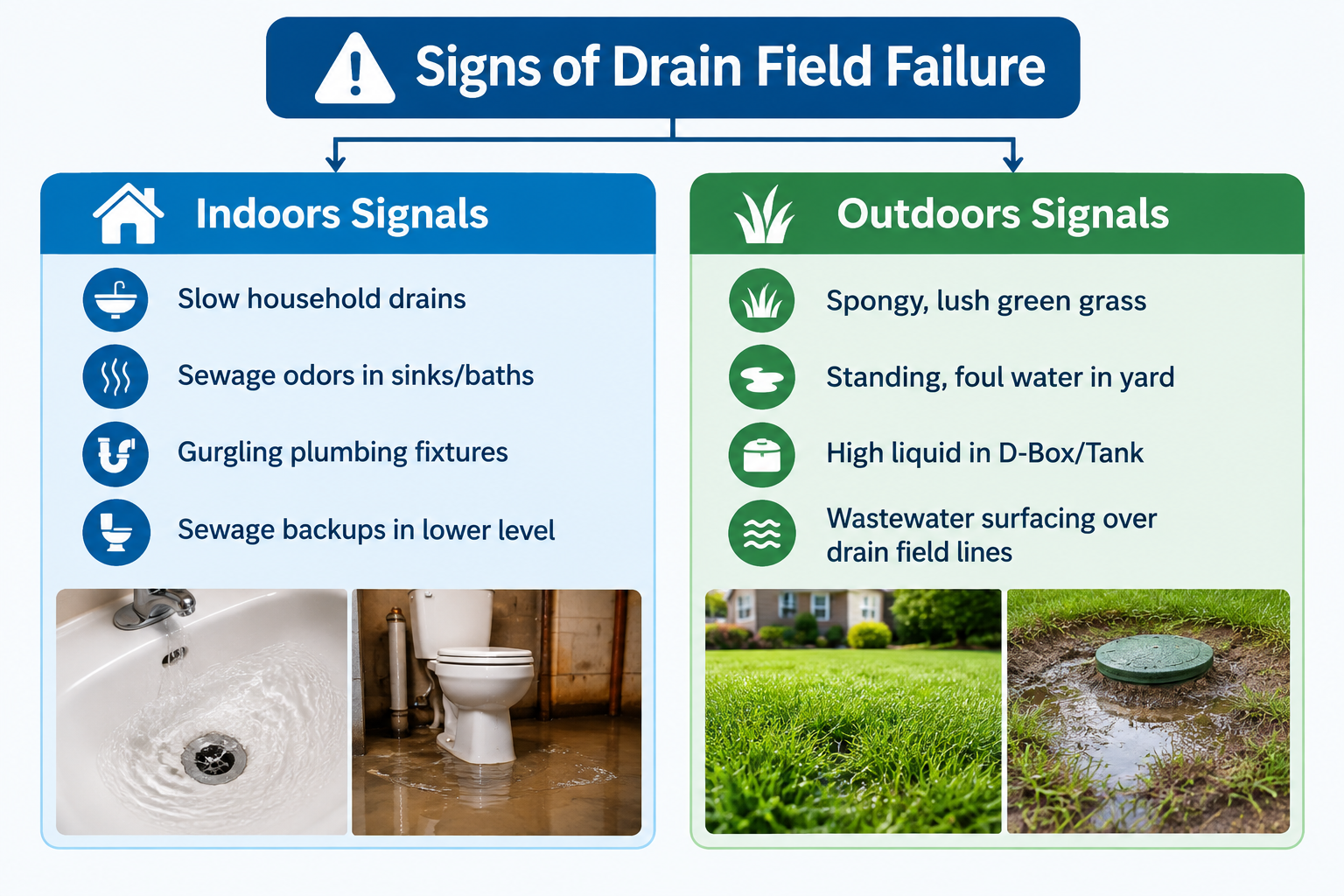
Signs inside the house
- Drains running slow all over the house, not just one sink
- Gurgling from toilets or drains, especially when the washing machine empties
- Sewage smells from floor drains or basement fixtures
- Backups into the lowest drain in the house — usually a basement floor drain or a downstairs shower
Signs outside
- A strip of grass that’s greener and taller than the rest of the lawn. That’s not good luck. That’s your lawn being fertilized by sewage rising toward the surface.
- Soggy, spongy ground over the field, especially when it hasn’t rained
- Standing water or black mud over the trench lines
- A rotten-egg smell in the yard
The single most useful thing to know: the greener-grass sign shows up long before the sewage-in-the-basement sign. If you’re seeing it now, act now. You may still be in repair territory.
How a professional confirms it
Checking the distribution box. They lift the lid on the box that splits flow between trenches. If water is standing above the outlet pipes, the soil can’t take any more — that tells them a lot in about two minutes.
A dye test. Non-toxic colored dye is flushed with a large amount of water. If colored water shows up in your yard within a day or two, the field has failed. Simple and hard to argue with.
A camera inspection ($200 to $500). A camera goes down the pipes to look for crushed pipe, tree roots, or collapsed soil. This is the step to insist on. It’s the difference between finding a $700 broken pipe and being sold a $15,000 replacement.
Why Drain Fields Fail — The Biomat Explained
Almost all drain field failures come down to one thing, and it has an ugly name: biomat.
What it is
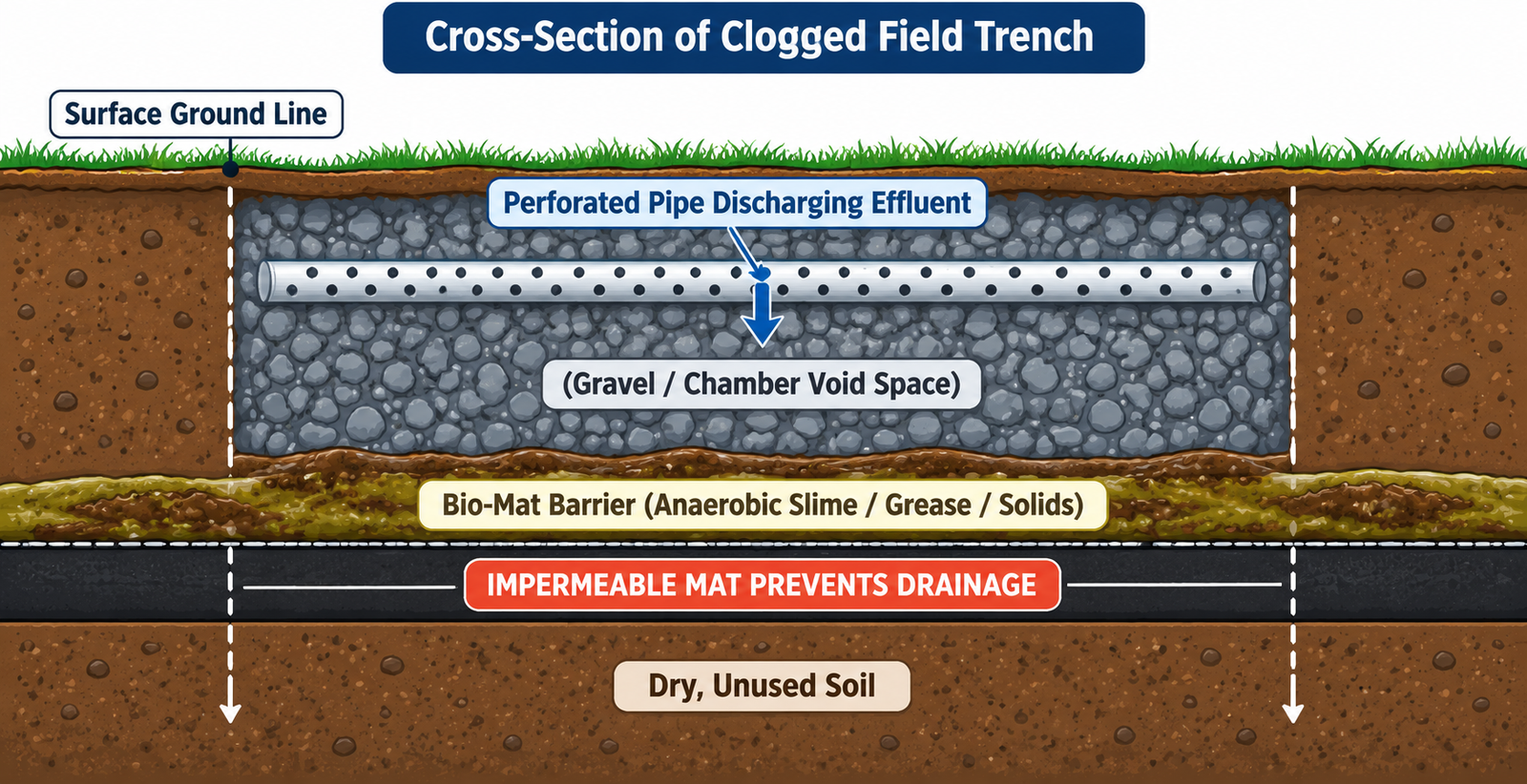
Biomat is a black, slimy layer that forms along the bottom and sides of your drain field trenches. It’s made of bacteria, organic waste, grease and solids.
The part that surprises people: a thin layer is good
A thin biomat is supposed to be there. It slows the water down just enough for bacteria to clean it properly before it reaches the groundwater. A field with no biomat isn’t filtering well.
How it goes wrong
When extra material gets into the field — grease, solids, lint, and food waste that should have stayed in the tank — that layer gets fed too well. It thickens. Eventually it turns into something close to a waterproof seal across the bottom of your trenches.
Now the water can’t get out. It backs up into the trenches, fills the tank, and comes up in your yard or back into your house.
And here’s the hard truth: once the biomat has fully sealed, it’s essentially permanent. That’s why prevention matters far more than repair.
The five things that cause it
- Not pumping the tank. By far the biggest one. Skip pumping for years and sludge fills the tank until it starts spilling straight into the field. Pump every 3 to 5 years.
- Grease down the drain. Fats and oils coat soil particles and make them repel water. Bacon grease is genuinely a drain field problem.
- Lint from synthetic clothing. Tiny plastic fibers from fleece and athletic wear float straight through the tank and plug the tiny gaps in the soil. A washing machine lint filter is cheap insurance.
- Too much bleach and drain cleaner. These kill the bacteria your tank depends on. Without them, waste doesn’t break down and goes into the field as solids.
- Too much water. A running toilet, a leaky faucet, or gutters draining onto the field keeps the soil permanently soaked, so it can’t absorb anything else.
Repairs That Might Save You a Replacement
Before you commit to a five-figure job, ask about these.
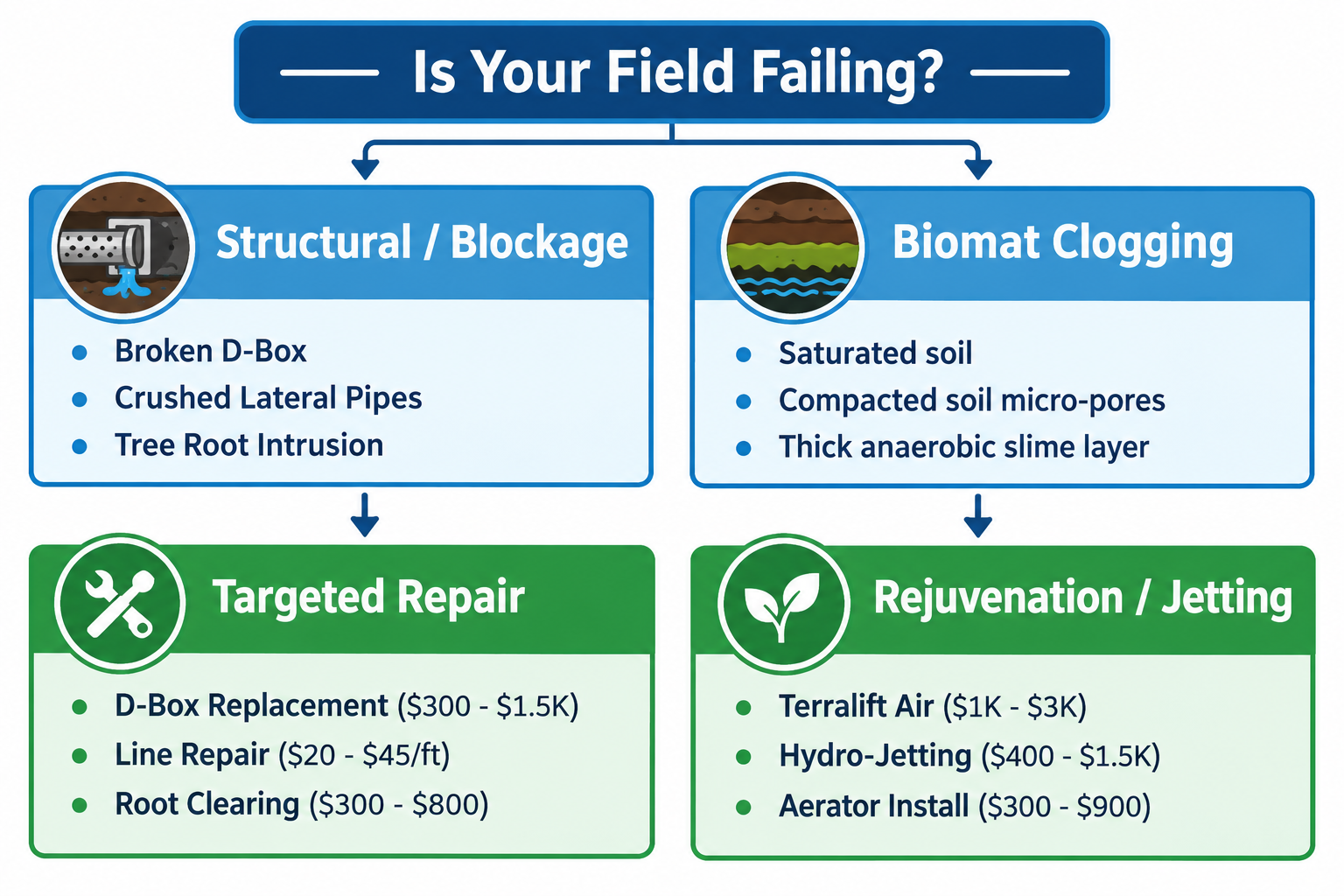
Fixing the distribution box — $300 to $1,500
The distribution box splits liquid evenly between your trenches. If it shifts or corrodes, one trench gets drowned while the others sit dry and unused. Fixing it can restore most of your field’s capacity for a few hundred dollars.
Always ask about this first. It’s a common problem with a cheap fix that mimics total failure.
Cleaning out the lines (hydro-jetting) — $400 to $1,500
High-pressure water is run through the pipes to blast out sludge, slime and small roots. Works well for blockages and light root intrusion. Won’t fix soil that’s already sealed.
Air fracturing the soil (often called Terralift) — $1,000 to $3,000
A probe is pushed several feet into the soil and fires compressed air, cracking open channels in the compacted ground. Small beads are injected to hold those channels open.
Sometimes it works well. Sometimes it buys a couple of years. It won’t save a field that’s completely sealed, but at a fraction of replacement cost it’s worth trying first.
Adding an aerator — $300 to $900
Adding oxygen to the tank encourages bacteria that eat the biomat slime, which can slowly restore absorption.
Just resting the field — free
Less well known: a saturated field can sometimes recover over three to six months if you drastically reduce the water going into it. That’s difficult in a lived-in house, but if you have a second bathroom you can shut down or a seasonal property, it’s worth asking a professional whether resting could help.
Fixing the tank so the field stops getting damaged — $300 to $900
If a broken baffle inside the tank is letting scum into the field, fixing it plus adding an effluent filter stops the damage from continuing. If you’re replacing your field, do this at the same time — otherwise the new field starts dying the same way the old one did.
A word of caution about chemical treatments — $200 to $600
Products that claim to dissolve biomat exist. Be careful. Strong acids and caustic chemicals can permanently damage soil structure, pollute groundwater and void your system’s warranty. Talk to a licensed septic professional before pouring anything into your system.
Moving the Drain Field to a New Spot
Why you can’t just build a new field on the old one
This surprises a lot of homeowners. The soil around a failed field is saturated with biomat, solids and bacteria. Put new pipes in that same soil and they’ll clog quickly.
Your two options are to move to a different part of the property, or to dig out the contaminated soil and haul in clean sand — which is often more expensive than moving.
This is exactly why every septic design includes a designated reserve area: a section of yard set aside for the future replacement field. If you don’t know where yours is, find out. And don’t build a shed, pool or driveway on it.
What moving costs
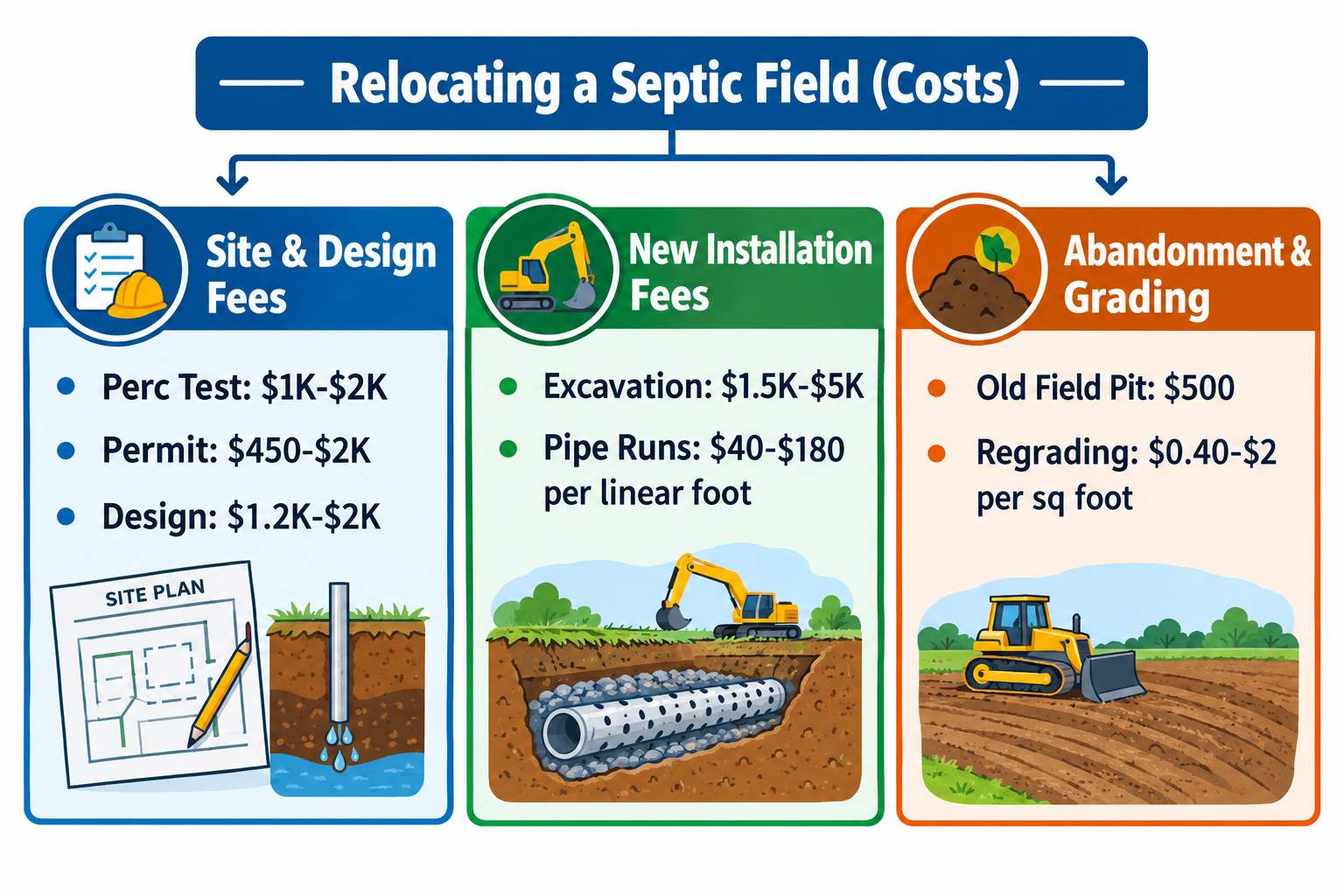
$5,500 to $21,500, depending on distance and site conditions.
Extra costs beyond a standard replacement:
- Running pipe to the new location: $40 to $180 per foot
- Clearing trees and brush: $500 to $3,000
- Properly closing the old field: $500 to $2,500 — codes usually require pumping out what’s left, crushing or removing old pipes, filling the trenches and regrading
Can You Do This Yourself?
Short answer: no, and this is one of the few home projects where that’s genuinely the right advice.
Why not
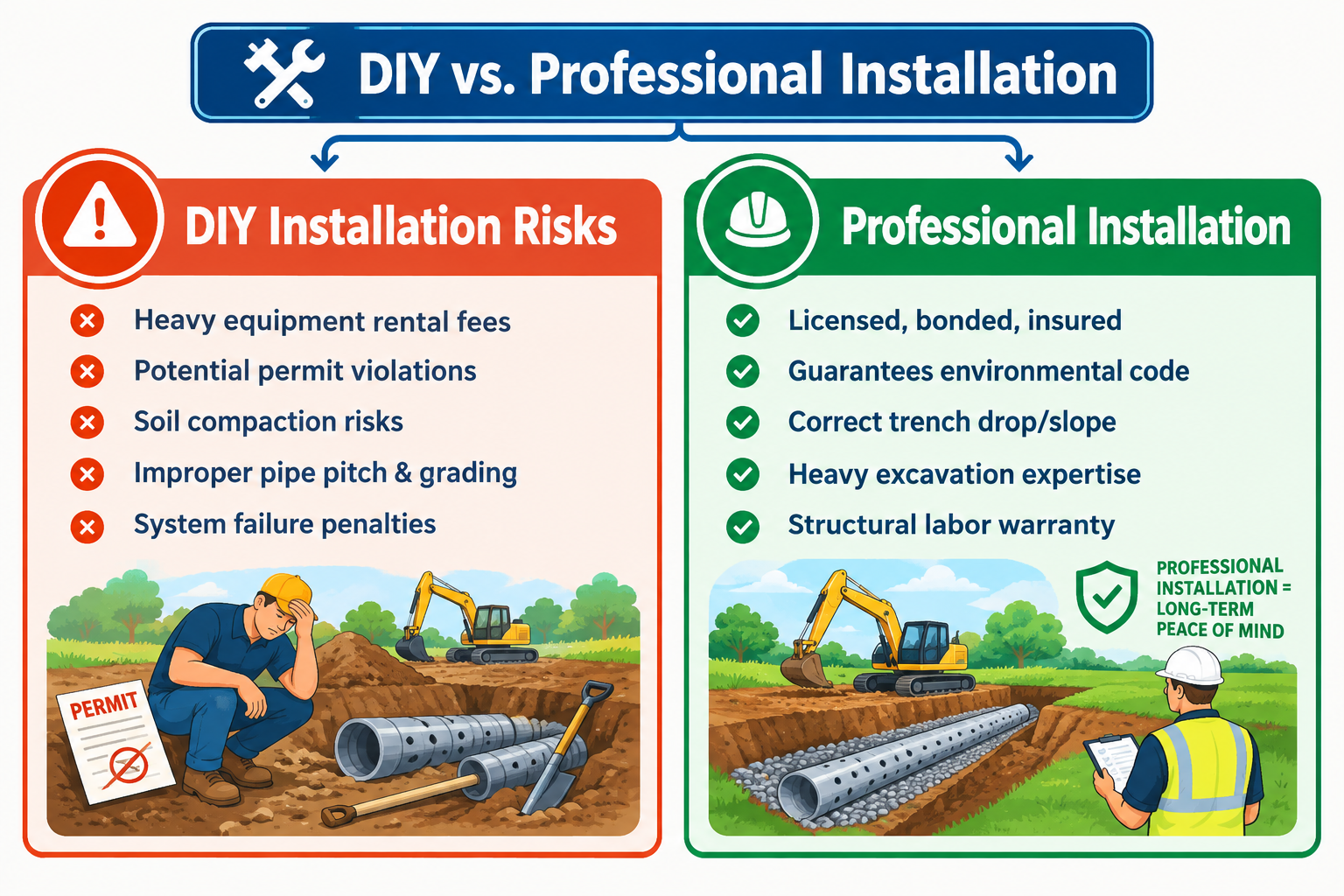
It’s usually illegal. Most counties require a licensed, bonded installer to pull the permit and do the work. Florida, for example, requires septic contractors to hold a specific state license. An unpermitted system means fines, stop-work orders, and a serious problem when you try to sell the house.
You can ruin the soil before you start. Drive an excavator across the area where the new field will go and you compact the soil, destroying the very absorbency you’re paying for. There’s no fixing that afterward.
The slope has to be exact. Drain lines need roughly a 1/8 inch drop per foot. Too steep and everything rushes to the far end and floods it. Too flat and liquid pools and clogs at the entry. That’s a precision job with heavy machinery.
Your insurance and your home sale both depend on it being done right. An inspector will find an unpermitted system.
What you can do to cut the bill
- Clear brush, saplings and obstacles from the work area before the crew arrives
- Handle the cleanup afterward — spreading topsoil, reseeding grass, restoring landscaping
- Move vehicles, equipment and fencing out of the access route
- Call 811 before any digging — it’s a free service that marks buried utilities, and it’s required by law
Ask your contractor what actually helps. Poorly done prep costs more than none.
Permits, Tests and Rules
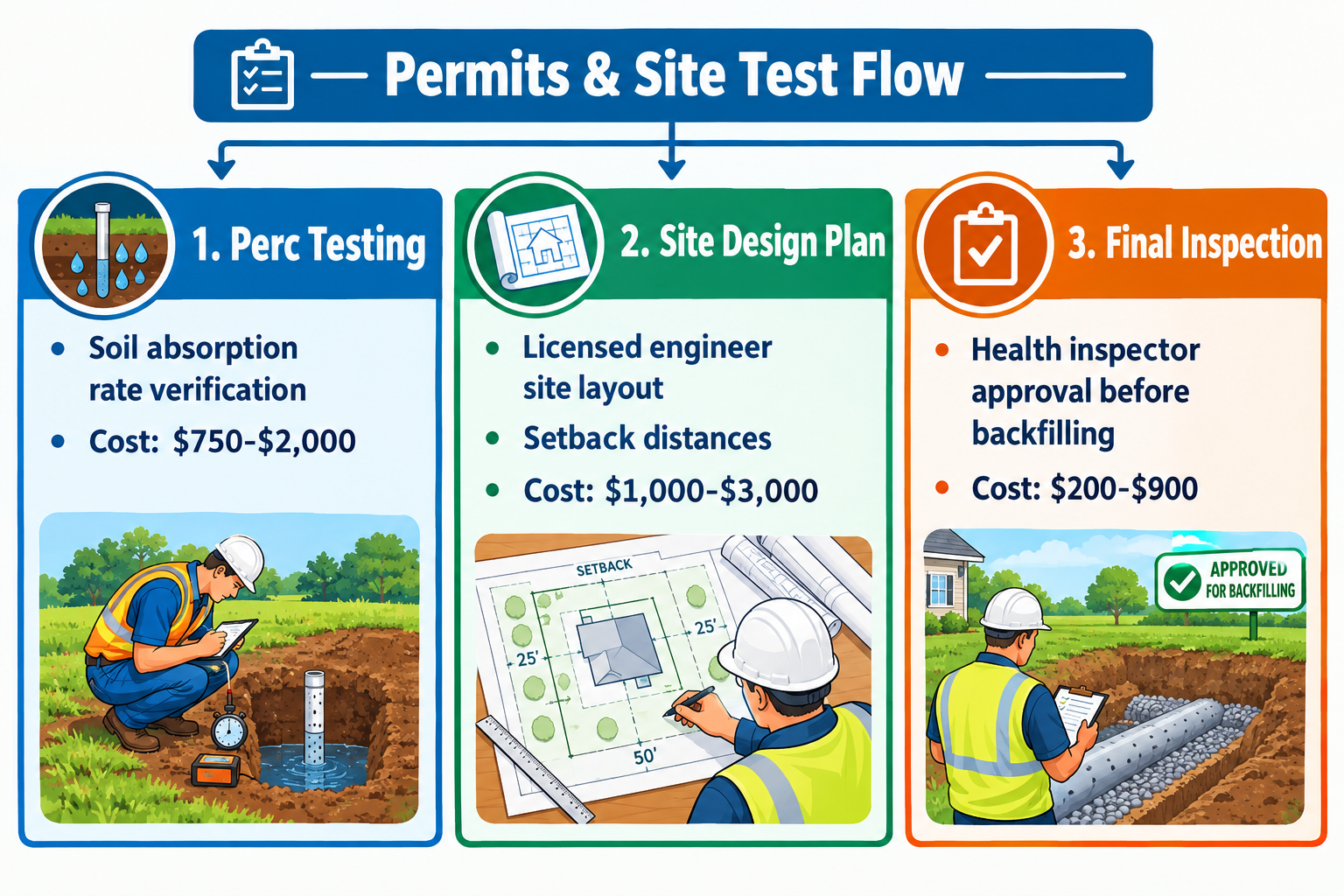
The soil test (perc test) — $500 to $2,000
A technician digs test holes, fills them with water, and times how fast it soaks away.
Why it decides your whole budget: fast-draining sandy soil means a small, simple, cheap field. Heavy clay or rock means a bigger field or an engineered system that costs two or three times as much.
Note that the test has to be done where the new field will go, not where the old one was.
Design and permits
Special systems need an engineer’s design ($1,000 to $3,000). Every system needs a county permit ($450 to $2,000).
An inspector must approve the work before it’s buried. Never let a crew backfill a system that hasn’t been inspected — if there’s a problem later, that inspection is your only protection.
Distance rules
Your field has to sit a minimum distance from things. These are typical; yours will be set locally.
| Distance from | Typical minimum |
|---|---|
| A drinking water well | 50 – 100 feet |
| Property lines | 10 – 20 feet |
| Lakes, streams, ponds | 50 – 100 feet |
| Your house foundation | 10 – 20 feet |
| Groundwater below the trench | 2 – 4 feet of dry soil |
That last one is why high water tables force mound systems. If there isn’t enough dry soil beneath the pipes to do the filtering, you have to build it above ground.
Hiring the Right Contractor
You’re about to spend as much as a used car. Spend an hour on this part.
Get three written quotes. Insist each one separates the soil test, design, permits, digging, materials and labor. Bundled quotes can’t be compared, and the spread between installers on the same job is routinely 30%.
Check the license. Most states have a licensing lookup online. Confirm they’re licensed, bonded and insured, and that the license covers septic work specifically.
Ask what happens if the soil test at the new site comes back bad. This is the biggest hidden variable in your budget. Get their answer before you sign.
Ask about the warranty — on both the materials and the labor, and how long each lasts.
Ask who pulls the permit. It should be them, not you.
Red flags
- Quoting a full replacement without a camera inspection or diagnostic
- Pressuring you to sign today
- Refusing to put the quote in writing, itemized
- Wanting a large cash deposit up front
- Being vague about permits, or suggesting you skip them
One money note
If money is the barrier, look into help before you sign anything. There are federal 1% loans, state water-quality grants, and county programs that help homeowners pay for septic work — and most of them will not reimburse work that started before you were approved. One phone call to your county health department before you hire someone can be worth thousands.
Making a New Field Last 25+ Years
A well-treated drain field lasts 25 to 30 years or more. A neglected one can fail in ten. The difference is almost entirely about habits.
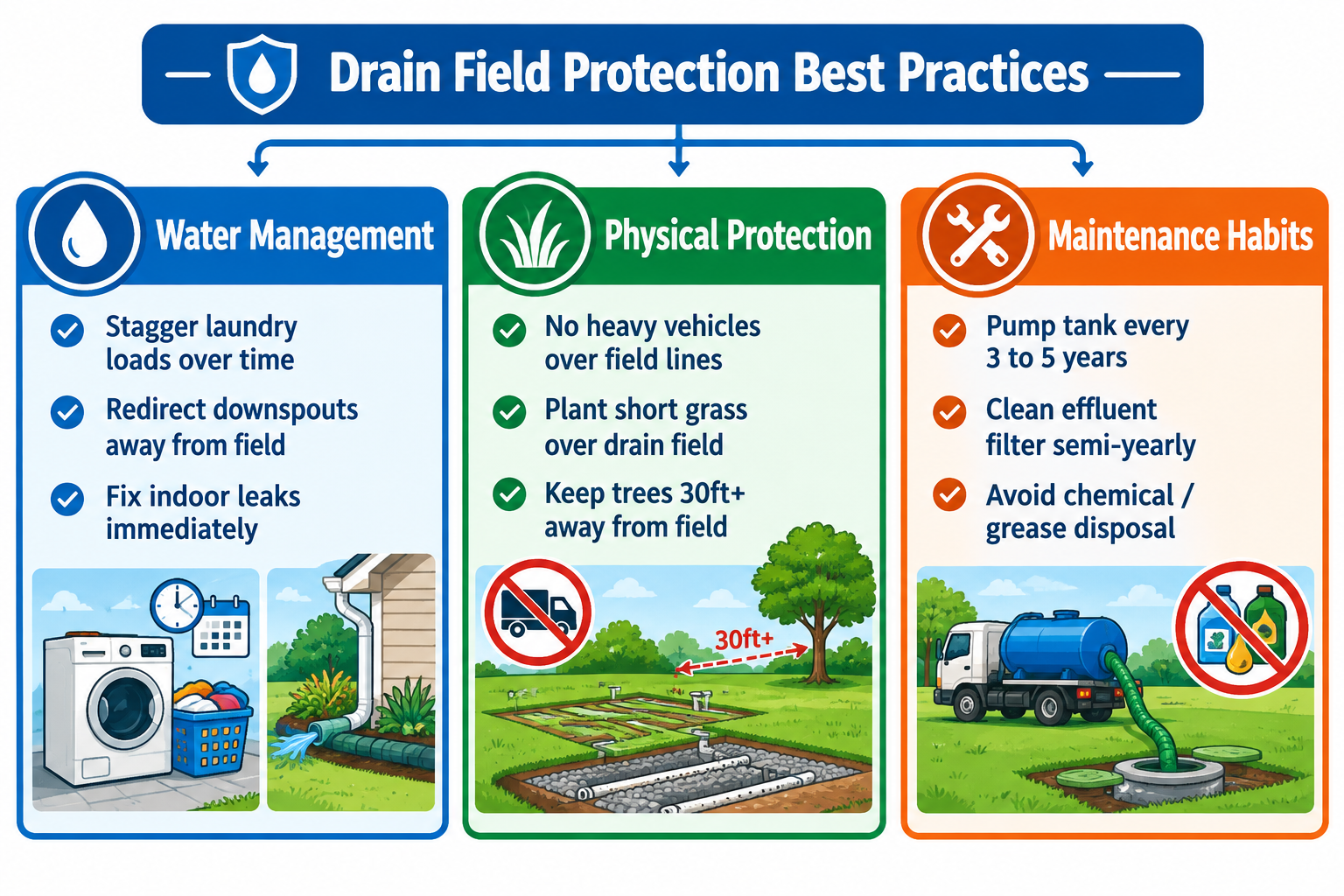
Pump the tank every 3 to 5 years
This is the single most important thing on the list. It costs $300 to $700 and it’s what keeps solids out of your field.
Add a garbage disposal and shorten the interval to every 2 years. Heavy disposal use is one of the fastest ways to kill a field.
The EPA recommends having the system inspected every 1 to 3 years as well.
Install an effluent filter and clean it yearly
A washable mesh filter at the tank outlet catches floating debris before it reaches the field. It costs $230 to $450 installed and takes five minutes a year to rinse. Best value in the whole system.
Spread out your water use
Six loads of laundry on Saturday pushes a wave of water through the tank and straight into the field, carrying solids with it. Spread them across the week.
Fix running toilets and dripping faucets immediately — a leaky toilet can quietly dump hundreds of gallons a day into your field.
Keep water off the field
Point gutters, downspouts, driveway drains and sump pump outlets away from the drain field. Soil that’s already soaked can’t absorb your wastewater.
Keep weight off the field
No cars, no trucks, no trailers, no equipment. No sheds, decks, pools or patios. Weight crushes the pipes and compacts the soil.
Watch what you plant
Grass over the field is ideal — it stabilizes the soil and helps draw out moisture. Keep trees and deep-rooted shrubs at least 30 feet away. Roots grow toward water and nutrients, and your drain field is full of both.
Watch what goes down the drain
Never flush wipes (including “flushable” ones), paper towels, feminine hygiene products, cat litter, coffee grounds, grease, paint, solvents or harsh chemicals.
And skip the additive products sold as septic treatments. A healthy tank grows the bacteria it needs on its own, and some additives cause harm by dissolving solids that then travel out to the field.
Common Questions
How long does a drain field replacement take?
The digging and installation take 2 to 5 days. But the whole process — soil test, design, permits, scheduling — usually takes 2 to 6 weeks. Longer if you need an engineered system.
Can I put a new drain field where the old one was?
Not usually. The soil there is saturated with biomat and solids, and a new field would fail quickly. You either move to a new area or dig out and replace the contaminated soil, which is often more expensive than moving.
What’s the cheapest kind of drain field?
A conventional pipe-and-gravel or plastic chamber system in good draining soil, at $5,000 to $12,000. But your soil test decides whether you’re allowed one — you can’t choose it to save money.
How long should a drain field last?
25 to 30 years with proper care. Early failures are almost always caused by not pumping the tank, heavy garbage disposal use, flushing things that don’t belong, or parking on the field.
Can tree roots really destroy a drain field?
Yes. Roots seek out moisture and nutrients, and your field has both. They grow in through the pipe holes, expand, block flow and eventually crack the pipes. Keep trees 30 feet back.
Does homeowners insurance cover this?
Usually not. Standard policies exclude damage from gradual wear, age and poor maintenance — which is exactly what drain field failure is. Coverage may apply if the damage was sudden and from a covered event, like a tree falling on the field or a vehicle crashing into it. Check your specific policy and don’t assume.
Can a failing field be saved without replacement?
Sometimes. A saturated field may recover with 3 to 6 months of much lower water use. Cleaning the lines, fixing the distribution box or air fracturing the soil all help in the right circumstances. But a field with crushed pipes, root damage or a fully sealed biomat needs replacing.
How do I know if it’s the tank or the field?
You often can’t tell from the symptoms — both cause slow drains and backups. That’s what the diagnostic is for. A technician checking the distribution box and running a camera can usually tell you in under an hour, and a tank problem is dramatically cheaper.
Why is my grass so green over the septic system?
Because effluent is rising close to the surface and fertilizing it. It’s an early warning sign, not a lucky patch of lawn. Get it looked at while repairs are still an option.
Can I build over my drain field or reserve area?
No. Not a shed, deck, pool, patio or driveway — over either the current field or the reserve area set aside for your future one. If you don’t know where your reserve area is, get a copy of your system’s design from the county health department.
Do I need a permit for a repair?
Small repairs sometimes don’t need one. Replacement always does. Ask your county health department — and be suspicious of any contractor who suggests skipping it.
Is there help paying for this?
Yes, potentially. Federal loans at 1% interest, state water-quality grants, and county assistance programs all exist for septic work. Call your county health department and your USDA Rural Development office before you hire anyone — most programs won’t pay for work that’s already started.