



Your septic system has failed, or the county has told you it has to be replaced. Someone has quoted you $8,000, or $15,000, or $25,000. You don’t have that money.
Here is the honest picture, before you spend hours filling in forms.
Free money for septic systems is real. Every year, real homeowners get real grants they never have to pay back. It is not a myth, and the good programs are not scams.
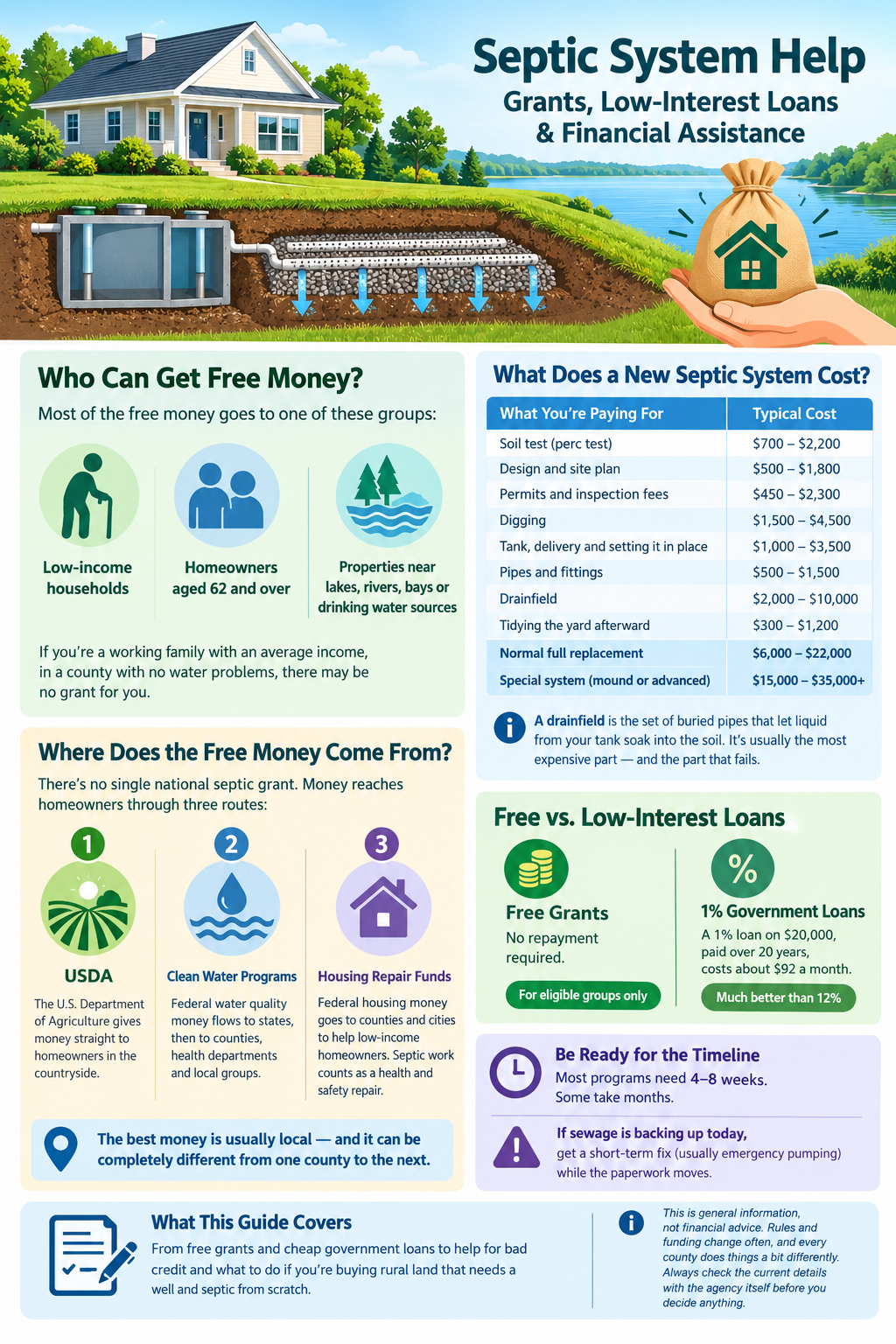
But not everyone can get it. Almost all free money goes to one of three groups:
- People with low incomes
- Homeowners aged 62 and over
- Anyone whose property sits near a lake, river, bay or drinking water source the government is trying to protect
If you’re a working family with an average income, in a county with no water problems, there may be no grant for you.
But there is almost certainly a cheap loan. And “cheap” here means 1% interest. A bank will charge you 12%. A 1% loan on $20,000, paid over 20 years, costs about $92 a month. That’s not a consolation prize. That’s an excellent deal, and most people who qualify never find out it exists.
Everything takes time. Most programs need four to eight weeks. Some take months. If sewage is backing up into your house today, you need a short-term fix — usually emergency pumping — while the paperwork moves.
This guide walks through all of it: free grants, cheap government loans, help for people with bad credit, and what to do if you’re buying rural land that needs a well and septic from scratch.
One note: this is general information, not financial advice. Rules and funding change often, and every county does things a bit differently. Always check the current details with the agency itself before you decide anything.
What You’re Trying to Pay For
Before you look for money, it helps to know what you’re paying for. Every application will ask.
What a new septic system costs
| What you’re paying for | Typical cost |
| Soil test (called a perc test) | $700 – $2,200 |
| Design and site plan | $500 – $1,800 |
| Permits and inspection fees | $450 – $2,300 |
| Digging | $1,500 – $4,500 |
| Tank, delivery and setting it in place | $1,000 – $3,500 |
| Pipes and fittings | $500 – $1,500 |
| Drainfield | $2,000 – $10,000 |
| Tidying the yard afterward | $300 – $1,200 |
| Normal full replacement | $6,000 – $22,000 |
| Special system (mound or advanced) | $15,000 – $35,000+ |
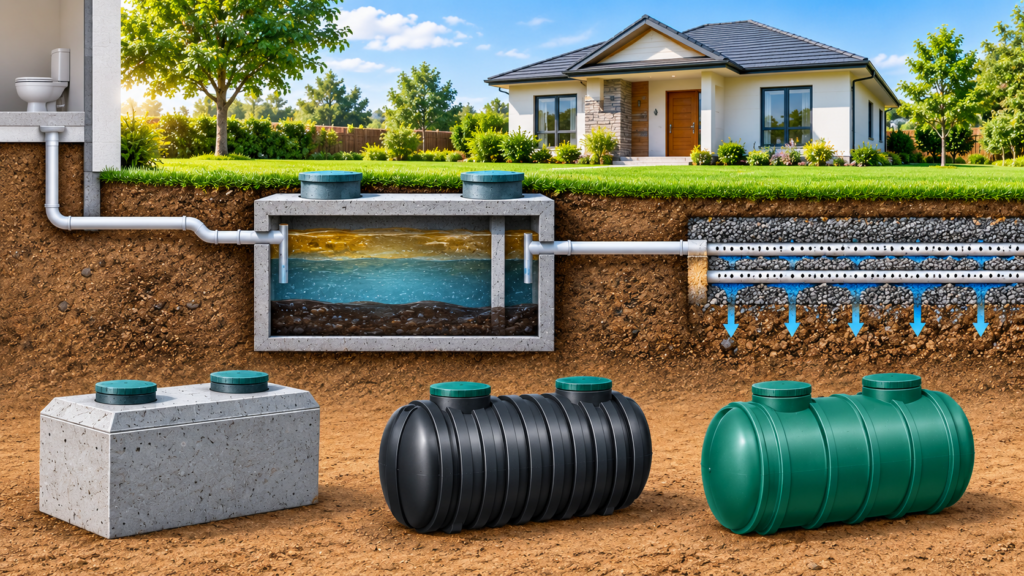
What’s a drainfield? It’s the set of buried pipes that let the liquid from your tank soak slowly into the soil. It’s usually the most expensive part, and it’s usually the part that fails.
Three reasons people need a new system
- It broke. Sewage backing up indoors, wet ground over the drainfield, or a bad smell in the yard. This is an emergency — and it’s also the exact wording most grant programs use. That works in your favor.
- The county told you to upgrade. A failed inspection when selling, or new rules where you live. You might be told to install an advanced system that costs far more than a normal one.
- You’re being connected to public sewer. Some areas make you switch. The hookup fee alone can be thousands.
Reasons 2 and 3 often unlock the best grants. If the government is making you do something, there’s usually money set aside to help you do it. Always ask.
Where the Free Money Comes From
There’s no single national septic grant you can apply for online. Money reaches homeowners through three routes.
- Route 1 — The USDA. This is the U.S. Department of Agriculture, and it’s the one federal agency that gives money straight to individual homeowners in the countryside. More on this below. It’s the biggest single opportunity for most people.
- Route 2 — Clean water money passed down from the federal government. Washington sends water quality money to the states. States pass it to counties, health departments and charities. Those local groups then help homeowners. This is where most state and county septic help comes from.
- Route 3 — Housing repair money for low-income homeowners. Federal housing money goes to counties and cities to fix up homes owned by people on low incomes. Septic work counts as a health and safety repair almost everywhere.
So when people search for free government grants for septic systems near me, the “near me” part is the key. The federal program is the same everywhere. But the best money is usually local — and it can be completely different from one county to the next.
Who actually gets free money
Be realistic before you spend a week on this. Grants go to:
- Homeowners 62 and over with very low incomes
- Low-income households generally
- Anyone living near protected water — sometimes no matter what you earn. This is the big exception, and it’s the one most people miss.
- Anyone with an official order from the health department
- Tribal households, through a separate and often more generous program
- People hit by a declared disaster
Don’t see yourself on that list? Skip to the loan sections. A 1% loan is worth having.
The USDA Program — The Main Federal Help
This is what most people mean when they talk about a septic tank grant. Its official name is the Section 504 Home Repair Loans and Grants program. It has two halves, and you can sometimes use both.
Half one: the grant (money you keep)
- You can get up to $10,000. That’s a lifetime limit, not per job. If you got $4,000 years ago, $6,000 is left.
- You must be 62 or older. There’s no way around this for the grant.
- You must not be able to afford a loan. The USDA checks this. The grant exists for people who genuinely can’t manage even a small monthly payment.
- The money must fix a health or safety problem. A failing septic system is a perfect example. It’s one of the most common uses of this grant.
- You never pay it back — unless you sell or transfer the property within three years. Then the whole amount becomes due. Stay past three years and it’s yours.
- In official disaster areas, the limit goes up to $15,000.
Half two: the loan (money you pay back very cheaply)
- You can borrow up to $40,000
- The interest rate is 1%, fixed. That is not a typo, and it doesn’t go up later.
- You get up to 20 years to pay it back
- Roughly $4.60 a month for every $1,000 you borrow. So a $15,000 septic system costs about $69 a month.
- There’s no age limit. This is the option if you’re under 62.
The part most people miss: you can use both
If you’re 62 or over, you can often get a grant and a loan together, up to $50,000 combined ($55,000 in disaster areas).
Here’s what that looks like in real life.
Your septic replacement is quoted at $18,000. The loan officer sets it up as a $10,000 grant plus an $8,000 loan. Your monthly payment is about $37. And $10,000 of that bill simply disappears — you never pay it back, as long as you stay in the home three years.
That combination is the best septic funding deal in the country. Hardly anyone knows about it.
Do you qualify? The four tests
You have to pass all four.
- Test 1: Your age. For the grant, 62 or over. Under 62 means loan only — which is still worth having.
- Test 2: Where you live. Your home must be in an area the USDA calls rural. This is stricter than “not a big city” but much looser than people assume. Plenty of small towns and edge-of-suburb areas qualify.
Go to the USDA Rural Development eligibility map and type in your exact street address. Don’t guess from your zip code — the lines are drawn street by street in some places, and neighbors can get different answers. - Test 3: Your income. Your household income has to be at or below the “very low income” limit for your county and family size. That’s roughly half the typical income in your area, but the real dollar figures are set county by county and updated every year.
Important: ask the local office to work out your income for you. They subtract certain things — medical costs, dependents, an allowance for older households — and those deductions push plenty of people under the line who assumed they were over it. Don’t rule yourself out on a guess. - Test 4: You can’t borrow affordably elsewhere. This isn’t about having bad credit. It’s about not having a realistic way to borrow at normal rates without real hardship.
The savings rule that catches people out
The government expects you to put your own savings toward the job first.
Roughly speaking, an older household can keep about $20,000 in savings, and a younger one about $15,000. Anything above that, they’ll expect you to spend on the repair before they help.
Retirement accounts and your home itself are usually treated differently from cash in the bank, so don’t count yourself out. Ask them to look at your actual situation.
A few other rules
- You must own the home and live in it. Landlords and renters can’t use this program. It won’t pay for a rental.
- Mobile and manufactured homes count if you own the home and the land (or have a long lease) and it’s on a permanent foundation.
- You can’t use it to buy a house. It’s only for repairs to a home you already own.
- If a storm or flood damaged your system, there’s a separate disaster fund with much bigger grants. Ask to be checked for both.
Other Federal Help Worth Knowing About
Clean water money through your county
This is the biggest pot of federal water money, and it’s what pays for most state septic programs. You can’t apply for it directly — it reaches you through your county health department or a local charity.
What to say when you call: ask whether they have “any homeowner assistance funded through the Clean Water State Revolving Fund.” Front desk staff sometimes don’t recognize “septic grant” but know exactly what that funding is.
Housing repair grants through your county
Federal housing money isn’t specifically for septic systems, but many counties use it that way — to fix sewage problems in homes owned by people on low incomes. It’s usually a grant, not a loan.
Where to ask: your county commissioners’ office, county housing authority, or local community action agency.
“Federal grants for sewer systems” — a common mix-up
Worth clearing this up. Most federal sewer money goes to towns and cities, not people. It builds treatment plants and main sewer lines. You can’t apply as a homeowner.
But it still matters to you. When a town gets money to run a new sewer line down your road, there is usually a second pot to help households pay their hookup costs. That’s where help with sewer line connection comes from. Ask about it early — that money usually disappears when the construction finishes.
If you’re a tribal member
The Indian Health Service builds water and wastewater systems for tribal homes, often at no cost to the family. This is a separate and frequently better route. Contact your tribal housing authority.
If you’re a veteran
There’s no specific VA septic grant. But VA housing adaptation grants and some state veterans’ funds can cover sanitation work as part of a bigger project. Worth asking if you’re a disabled veteran.
State and County Help — Often the Best Money
State and local programs are frequently more generous than federal ones, and many have no age limit at all. Spend your time here.
Florida
Florida has some of the strongest funding in the country, because of the Indian River Lagoon, the springs, and pollution rules.
- Brevard County’s lagoon program gives homeowners up to $20,000 to upgrade a normal septic system to an advanced one that removes nitrogen, where hooking up to sewer isn’t possible. How much you get depends on how much pollution your system is estimated to produce.
- The county can pay your contractor directly, which solves the problem of not having cash up front. Not every contractor accepts this, and some ask for a deposit — ask before you choose one.
- You must be approved before any work starts. Start early and you get nothing. This rule applies almost everywhere and is the number one way people lose funding.
- State environmental grants also fund sewer conversions and upgrades through local governments.
- If you’re in Grant-Valkaria, you’re in Brevard County — so the county’s lagoon programs are your route. Call Brevard County Natural Resources, not the town office. Town-level septic grants are rare; county-level ones are common.
Ohio
- State clean water money goes to county health departments, which then help lower-income homeowners repair or replace failing systems. Help is often on a sliding scale — the less you earn, the more they cover, sometimes all of it.
- Apply through your county health department, not the state. Every county has its own forms, income limits and yearly budget. Some run out of money early in the year, so call in January if you can.
- Housing repair funds are also used for sewage problems in some Ohio counties.
New York
New York’s septic replacement program gives money to participating counties to help homeowners replace systems that are polluting listed lakes, rivers and bays. Whether you qualify depends mostly on where your property drains to, not what you earn.
Some counties add their own money on top. Nassau County offers up to $20,000 for replacing a failing system with a nitrogen-reducing one. Several Long Island towns add more.
Maryland
The Bay Restoration Fund covers up to around $10,000 per household for upgrading to a nitrogen-reducing system, aimed at properties in the Chesapeake Bay area. Your county runs it, so timing varies.
Massachusetts
Two useful options:
- A state tax credit of up to $6,000 toward repairing or replacing the system at your main home. You can only claim $1,500 a year, spread over up to four years. It’s money back rather than money up front, but it’s real.
- Town loans added to your property tax bill. The state lends towns money cheaply, towns lend it to homeowners, and you repay through your tax bill over many years. Some towns offer 0% to lower-income residents.
Delaware
The state runs a septic rehabilitation grant for low-income homeowners replacing failing systems and cesspools, including sewer hookup costs.
Worth knowing: it stopped taking new applications in early 2026 because so many people applied, then reopened that March. Programs open and close. If yours is closed when you call, ask when it reopens and whether there’s a waiting list.
Other states with programs
| State | What’s available |
| Michigan | State loan program for septic repairs, applications accepted year-round |
| Pennsylvania | Low fixed-rate septic loans, fairly quick turnaround |
| Virginia | Water quality money through soil and water conservation districts |
| North Carolina | County health department help, plus 1% charity loans |
| Minnesota | Low-interest loans for septic upgrades |
| Washington | Loan programs through county health districts |
| Wisconsin | County-run replacement help for those who qualify |
| Georgia, South Carolina | 1% charity loans plus county repair funds |
This list isn’t complete, and programs change every year. The reliable way to find yours is the three phone calls below.
How to Apply, Step by Step
Step 1: Get proof that your system has failed
Nearly every program wants proof. Get one or both of:
- A written report from a licensed septic contractor saying the system has failed and why
- An official notice from your county health department
That health department notice is worth more than you’d think. It turns your situation from “a homeowner wants an upgrade” into “a documented health hazard” — which is exactly what the money is set aside for. If an inspector has already visited, ask for the notice in writing.
Step 2: Make three phone calls
Do these in order. It takes one afternoon.
- Call 1 — Your county health department. Ask for the environmental health division. Say: “Do you have any grant or loan programs to help homeowners repair or replace a failing septic system?” They’ll also know about any local water protection money, which is the most generous and the least advertised.
- Call 2 — Your USDA Rural Development office. Search online for “USDA Rural Development office” plus your state. Ask to be checked for a Section 504 grant, loan, or both. Do this even if you think you earn too much. The income math includes deductions you probably don’t know about.
- Call 3 — Your county commissioners’ office or community action agency. Ask about housing repair grants for homeowners.
Those three calls cover most of the real money in almost any county in America.
Step 3: Check whether your address qualifies
Use the USDA eligibility map and enter your full street address. Save a screenshot — some applications want it.
For state water programs, ask whether your property is inside the boundary. These lines are drawn precisely, and being one street outside can disqualify you.
Step 4: Get your paperwork together
Have all of this ready before you apply. Missing paperwork is the main reason applications stall for months:
- Tax returns, usually the last two years
- Recent pay stubs, or your Social Security, pension or disability award letter
- Two or three months of bank statements
- Proof you own the home — your deed or property tax bill
- Proof you live there — a utility bill in your name
- Photo ID for every adult in the house
- Your home insurance page
- Two or three written quotes from licensed septic contractors
- The failure report or health department notice from Step 1
- Records of medical bills or dependents, if you’re claiming those deductions
Step 5: Apply, then stay on it
- Get the name and direct phone number of the person handling your file. These programs often have one busy person running them, and files move faster when you can call a real human.
- Ask when their funding year runs. Some take applications all year. Others open once or twice a year, and missing the window means waiting months.
- Say clearly if it’s an emergency. If raw sewage is surfacing or backing up, use those words. Many programs can speed things up for a genuine health hazard — but only if you tell them.
- Follow up every two weeks. Politely. Files really do get stuck.
How long it all takes
- USDA: a quick chat within a week, then usually four to eight weeks for a decision
- State and county programs: anywhere from three weeks to six months
- Emergencies can sometimes be rushed through
The mistake that costs the most money
Do not start the work before you’re approved.
Almost no program will pay you back for work that started before the paperwork was signed. Homeowners lose thousands this way every year — there’s an urgent problem, a contractor who can start Monday, and a grant that becomes worthless the moment the digger arrives.
If you can’t wait, ask the program what you’re allowed to do in the meantime. Emergency pumping to keep your house usable is normally fine. Installing the new system is not.
Cheap Loans and Payment Plans
No grant? Don’t give up. These loans are far better than anything a bank will offer, and much easier to qualify for.
The USDA loan — the one to beat
- Up to $40,000
- 1% fixed for up to 20 years
- No age limit
- For lower-income rural homeowners
- Can be combined with the grant if you’re 62 or over
A $20,000 septic system costs about $92 a month on these terms. Compare every other offer against that number.
1% loans from rural charities
Two non-profits — SERCAP in the Southeast and RCAP Solutions in the Northeast — offer a well and septic loan backed by the USDA.
- Up to $15,000
- 1% fixed interest
- Usually up to 10 years to repay
- For repairing or replacing a well or septic system
Where it’s available: Delaware, Maryland, Virginia, North Carolina, South Carolina, Georgia and Florida through SERCAP. Maine, New Hampshire, Vermont, Massachusetts, Connecticut, Rhode Island, New York, New Jersey, Pennsylvania, Puerto Rico and the U.S. Virgin Islands through RCAP Solutions.
Why call even if the USDA said no: their income rules are looser. They help low-to-moderate income households, not just very low income. Plenty of families who fail the federal test qualify here. Other regional partners cover the Midwest, South and West — search for the RCAP office covering your state.
State and county loan programs
Many states run their own cheap loan funds. They come in three shapes:
- Direct state loans. Michigan and Pennsylvania both run these with year-round applications and reasonably quick decisions.
- Loans added to your property tax bill. Used in Massachusetts and elsewhere. The town lends you the money, and you repay it through your property taxes over 10 to 20 years.
- County revolving funds. Your county lends from a pot that refills as earlier borrowers repay. Rates are usually 0% to 3%.
Ask your county health department about all three.
Financing tied to your property, not your credit score
There’s a type of financing (often called PACE) where the loan is attached to your property and repaid through your property tax bill.
- They look at your home equity and whether you pay your property taxes on time — not your credit score
- 10 to 30 years to repay
- Rates around 5% to 10%
The honest downsides: it creates a claim on your property that sits ahead of your mortgage, which can cause trouble when you sell or refinance, and some mortgage lenders don’t like it. It’s only available in a handful of states, and not every program covers septic work. Read the terms carefully, and ask a housing counselor if you’re unsure.
Government-backed home improvement loans
The FHA insures home improvement loans made through regular lenders. Credit requirements are more relaxed than normal bank lending, and you don’t need much equity. Often overlooked. Worth asking your bank about.
Borrowing against your home
If you have equity, a home equity loan or line of credit is usually the cheapest private option, because your house secures the loan.
But that’s also the risk. Miss payments and you’re risking your home, not just your credit score. Only take this route if the payment genuinely fits your budget.
Your local credit union
Credit unions often run well and septic loans under rural programs, with friendlier credit standards than big banks and much better rates than online lenders.
If you’ve banked with one for years, go in person and bring your health department notice. A local lender can make a judgment call that a computer won’t. This should be one of your first calls, not your last.
Personal loans
Fast, easy, no collateral — and expensive. Usually 7% to 24% depending on your credit. Fine as a short-term bridge while you wait for grant money. Not a first choice.
Financing through your septic contractor
Many installers can arrange financing right when they quote the job. Convenient and fast, and sometimes without a hard credit check.
Two things to watch:
- The cost is sometimes hidden in a higher price for the job itself.
- “No interest for 12 months” deals often charge you all the backdated interest if you haven’t cleared the balance in time.
Always ask for the interest rate in writing, and compare it against a credit union quote before you sign.
All Your Options Side by Side
| Option | Credit needed? | Cost | How much | Best for |
| USDA grant | No | Free | Up to $10,000 | Low-income rural homeowners 62+ |
| USDA loan | Flexible | 1% | Up to $40,000 | Low-income rural homeowners, any age |
| USDA grant + loan together | Flexible | 1% on the loan part | Up to $50,000 | Rural homeowners 62+ with a big bill |
| State water quality grant | Usually no | Free | $5,000 – $20,000 | Anyone near protected water |
| County housing repair grant | No | Free | Varies | Low-income homeowners |
| SERCAP / RCAP loan | Loose criteria | 1% | Up to $15,000 | Low-to-moderate income in those states |
| Town loan on your tax bill | Varies | 0% – 5% | Varies | Homeowners in participating towns |
| PACE (property-based) | No credit check | 5% – 10% | Varies | Equity-rich, credit-poor owners |
| Home equity loan | Medium | Lower than personal loans | Based on equity | Owners with equity and steady income |
| FHA home improvement loan | Flexible | Varies | Varies | Owners without much equity |
| Credit union loan | Often flexible | Often good | Varies | Everyone — always worth one call |
| Personal loan | Usually 600+ | 7% – 24% | Varies | Speed, or bridging a wait |
| Contractor payment plan | Flexible | Varies | The job cost | Emergencies needing work now |
Work down this table in order. Only move to the next row after you’ve been formally turned down on the one above.
Why it matters: on a $20,000 job over 10 years, the difference between the 1% loan at the top and an 18% loan near the bottom is more than $15,000 in interest. Same hole in the ground. Wildly different price.
What If Your Credit Is Bad?
You still have real options. Here they are, cheapest first.
1. Apply for the grants and 1% loans anyway
This is the most important thing in this section.
Government programs are not built around your credit score. The USDA’s test is whether you can afford the payments and whether you could borrow elsewhere — a low score can actually help your case for a grant, not hurt it.
People with poor credit skip these programs every day because they assume they’ll be rejected, then take an 18% loan instead. Please don’t do that. Apply first, and let them tell you no.
2. Property-based financing (PACE)
Judged on your equity and property tax history, not your credit score. A genuine no-credit-check route where it’s offered — with the downsides described earlier.
3. Your credit union
Go in person. Bring the health department notice. Local lenders can make exceptions that big banks can’t.
4. Ask your contractor about payment plans
Many do soft credit checks. Just ask directly: “Do you offer payment plans, and do you run a hard credit check?”
5. Home equity, if you have it
Secured loans care much less about your credit score than unsecured ones.
Be careful with “no credit check” offers
Some are fine. But rent-to-own deals and high-cost installment plans can end up costing close to double the price of the job.
Before signing anything, ask for three numbers in writing:
- The interest rate (APR)
- The total amount you’ll have paid by the end
- Any penalty for paying it off early
If a salesperson won’t put those in writing, you have your answer.
Buying Land That Already Has a Well and Septic
This part is for buyers rather than existing homeowners.
Rural land looks cheap until you price the utilities. A well runs $5,000 to $15,000 or more. A septic system runs $6,000 to $22,000 or more. Running electricity to a remote lot can be $10,000. And if the soil fails its test, you may own land you can’t legally build on at all.
That’s why so many buyers look for owner financed land that already has a well and septic — where the seller finances the purchase directly instead of a bank. These listings are especially common in Florida, Texas, Missouri, Arkansas and Tennessee.
Why people like it
- No bank. You deal with the seller. A person decides, not a policy — which opens the door for buyers who can’t get a land loan.
- The risky part is done. A lot with a permitted septic system has already passed its soil test. You’re not gambling on soil that might force a $30,000 special system.
- One payment. Utility costs are built into the monthly payment instead of needing separate financing you’d struggle to get.
- Quick closing. Weeks, not months.
What you must check yourself
Owner financing removes the bank — and banks, whatever their faults, check things for you. Now that’s your job.
- Get the septic permit and inspection records from the county health department. Was it permitted? Inspected? Approved? How old is it? An unpermitted system becomes your problem the day you buy.
- Pay for your own inspection of the septic system, and get the well water tested for quality and how much it produces.
- Check the system is big enough for the house you plan to build. A system permitted for a two-bedroom home won’t legally serve a four-bedroom one.
- Get a title search and title insurance. Occasionally people sell land they don’t fully own or that has debts attached.
- Understand what you’re signing. With some contracts, the seller keeps legal ownership until you’ve paid in full — and in some states, missing payments can mean losing both the land and everything you’ve already paid. Other contracts give you ownership right away with much better protection. Know which one you have.
- Ask about a balloon payment. Owner financing often requires you to pay off the whole remaining balance after three to five years. If you can’t refinance by then, you’re in trouble. Get this in writing.
- Have a real estate attorney read the contract. A few hundred dollars here is the best money you’ll spend in this whole process.
Owner-financed land with utilities is a real and useful route to owning property. You just have to do the checking yourself.
How to Spot a Scam
Where there’s desperation and free money, there are scammers. Real government programs never:
- Charge you a fee to apply. Applying is always free.
- Contact you first by phone, text or Facebook to say you’ve won a grant you never applied for.
- Ask for a payment to “release” your funds, or ask for gift cards, wire transfers or crypto.
- Ask for your bank login or Social Security number on a call you didn’t make.
- Guarantee approval before looking at your file.
Two more warnings:
- Don’t pay someone to write your application. These forms are designed for ordinary homeowners, and the agency itself will help you for free.
- Be careful with contractors who say they’ll “handle the grant for you” and want you to sign before funding is confirmed. A good contractor will happily give you the written quote your application needs and wait. The ones pushing you to start now are the ones who cost people their funding.
If you’re unsure whether something is real, look up the agency’s phone number yourself on an official .gov website and call them. Never use a number the caller gave you.
Ways to Lower the Bill
Finding money is half the job. Spending less is the other half.
Get three itemized quotes. Insist that the tank, labor, permits and drainfield are priced separately, so you can actually compare. The gap between installers on the same job is often 30%.
Ask whether it can be repaired instead of replaced. Not every problem needs a whole new system. A broken internal wall, a cracked pipe or a clogged filter can be a few hundred dollars. Get a second opinion before accepting a $20,000 diagnosis — especially from the person selling the $20,000 replacement.
Ask about restoring the drainfield. Some failing drainfields can be revived for a fraction of replacement cost. It doesn’t always work, but it costs nothing to ask.
Book in the fall. Quotes are often 10% to 15% cheaper than in the spring rush.
Do the prep work you’re allowed to do. Clearing access, moving fencing and shifting equipment yourself can cut real hours off the bill. Ask the installer what actually helps.
Check for a tax credit. Massachusetts gives up to $6,000 back over four years. A few other states have something similar. Ask whoever does your taxes.
Combine programs where allowed. Lots of people use a county grant plus a cheap loan for the rest. Ask each program whether they allow this — some do, some don’t.
Don’t buy a smaller tank to save money. A tank that’s too small for your number of bedrooms may not be permitted, and it will fail inspection when you sell. This is the one place where saving money is guaranteed to cost you.
Common Questions
Are free government grants for septic systems real, or is it a scam?
They’re real. Federal, state and county programs all give out money that’s never repaid. What’s fake is anyone charging you a fee to apply, or contacting you out of the blue about an award.
How do I find help near me?
Three calls: your county health department, your USDA Rural Development office, and your county commissioners’ or community action agency. Local programs are barely advertised, and those three calls cover most of what exists.
How much is the USDA grant?
Up to $10,000 in your lifetime, or $15,000 in an official disaster area. You can combine it with a USDA loan for up to $50,000 total.
Who qualifies for the USDA grant?
You need all four: 62 or older, a home in a USDA-designated rural area, a household income at or below your county’s very-low-income limit, and no affordable way to borrow elsewhere. You also have to own and live in the home.
I’m under 62. Is there anything for me?
Yes. The USDA loan half has no age limit — 1% for up to 20 years. And most state grants don’t have an age rule at all, especially the water quality ones.
Do I have to pay the USDA grant back?
Only if you sell or transfer the property within three years. After that it’s yours.
Can I get a grant if I’m not low income?
Sometimes. Water protection programs often care more about where you live than what you earn. If you’re near a protected lake, bay or river, ask regardless of income.
Can I finance a septic system with bad credit?
Yes. Government programs aren’t credit-score driven, property-based financing looks at your equity instead, credit unions are flexible, and many contractors offer payment plans. Apply to the cheap options first — bad credit doesn’t rule you out.
Is “no credit check” financing legitimate?
Some of it is. But some rent-to-own and installment deals are very expensive. Always get the interest rate, the total repayment, and any early-payoff penalty in writing before signing.
What help is there in Florida?
Mostly county programs, especially Brevard County’s lagoon grants of up to $20,000 for advanced septic upgrades. The state also funds sewer conversions through local governments, and 1% charity loans are available to Florida homeowners.
What about Ohio?
State clean water money goes to county health departments, which help lower-income homeowners with repairs and replacements, often on a sliding scale. Apply through your county, not the state.
What is the septic system replacement fund?
That’s New York’s program, which helps homeowners replace systems that pollute listed waterbodies. Other states run similar funds under different names — ask your county health department what yours is called.
Can I get help for a rental property I own?
Not through the USDA program, which requires you to live in the home. Some state water quality programs do fund rentals, since the pollution is the same either way. Worth asking.
How long does it take?
Usually four to eight weeks for a USDA decision. Three weeks to six months for state and county programs. Say clearly if you have an active health hazard — many programs can speed that up.
Can I start the work while I wait?
No. Almost every program refuses to pay for work started before approval, and this is the most common way people lose funding. Emergency pumping is usually allowed. Installing the system is not. Confirm with your program.
Can I use more than one program?
Often yes. A common combination is a county grant plus a cheap loan for the rest. Ask each program directly.
Is there help with connecting to public sewer instead?
Yes. When a town gets funding to extend sewer lines, there’s usually money to help households pay hookup costs. Ask early — it’s tied to the construction schedule.
What if I’m turned down?
Ask why, in writing. The reason tells you where to go next. Too much income points to the charity loans. Outside the rural boundary points to county housing funds. Under 62 points to the loan half of the same program.
Do these programs cover wells too?
Usually yes. The USDA covers wells as a health and safety issue, and the SERCAP and RCAP loans are specifically for wells and septic systems. If both need work, say so — one application is easier than two.