



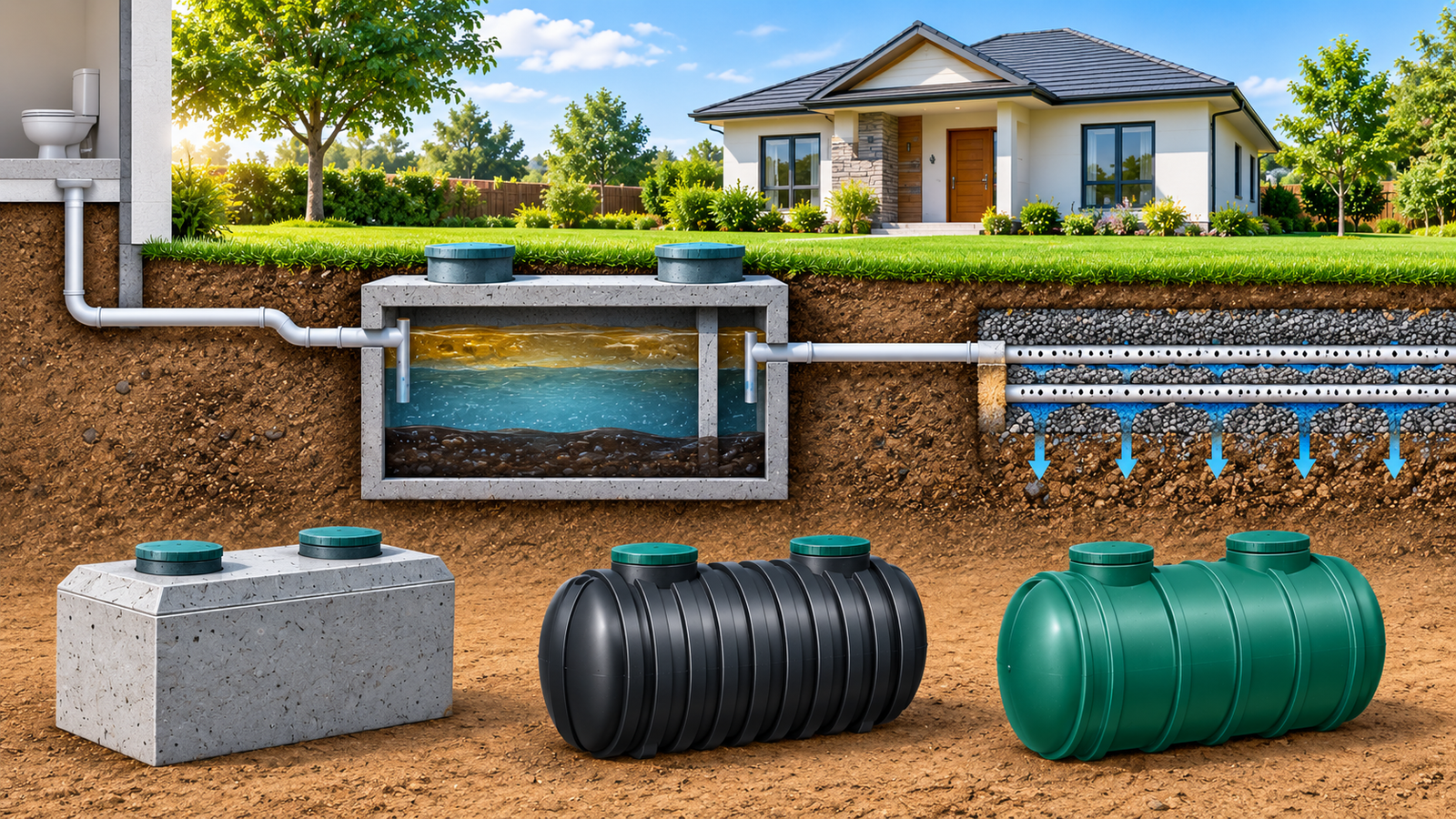
For most homes, a concrete septic tank is the safest choice. It is strong, it is cheap for what you get, it is too heavy to ever float out of the ground, and it is the only type you can bury under a driveway. Pick a plastic tank instead if a big delivery truck can’t reach your yard, or if your soil is acidic. Pick a fiberglass tank if you want concrete-level strength but need something light enough for a small digger to carry.
Rough prices: a 1,000-gallon tank costs about $900 to $2,000 on its own. Once you add digging, pipes and permits, it’s about $4,000 to $8,000 installed. A brand-new system with a full drainfield runs $6,000 to $22,000 or more.
A Quick Word on How a Septic Tank Works
Everything that goes down your drains flows into a buried tank. Inside, heavy solids sink to the bottom as sludge. Grease and light stuff floats on top as scum. The fairly clear liquid in the middle — called effluent — flows out the other end into a drainfield, which is a set of buried pipes that let the liquid soak slowly into the soil. The soil finishes cleaning it.
Two things follow from that. First, the tank’s only real job is to hold solids back so they never reach the drainfield. Second, if solids do get through, the soil clogs and the drainfield dies. That’s the expensive failure, and almost everything in this guide is really about preventing it.
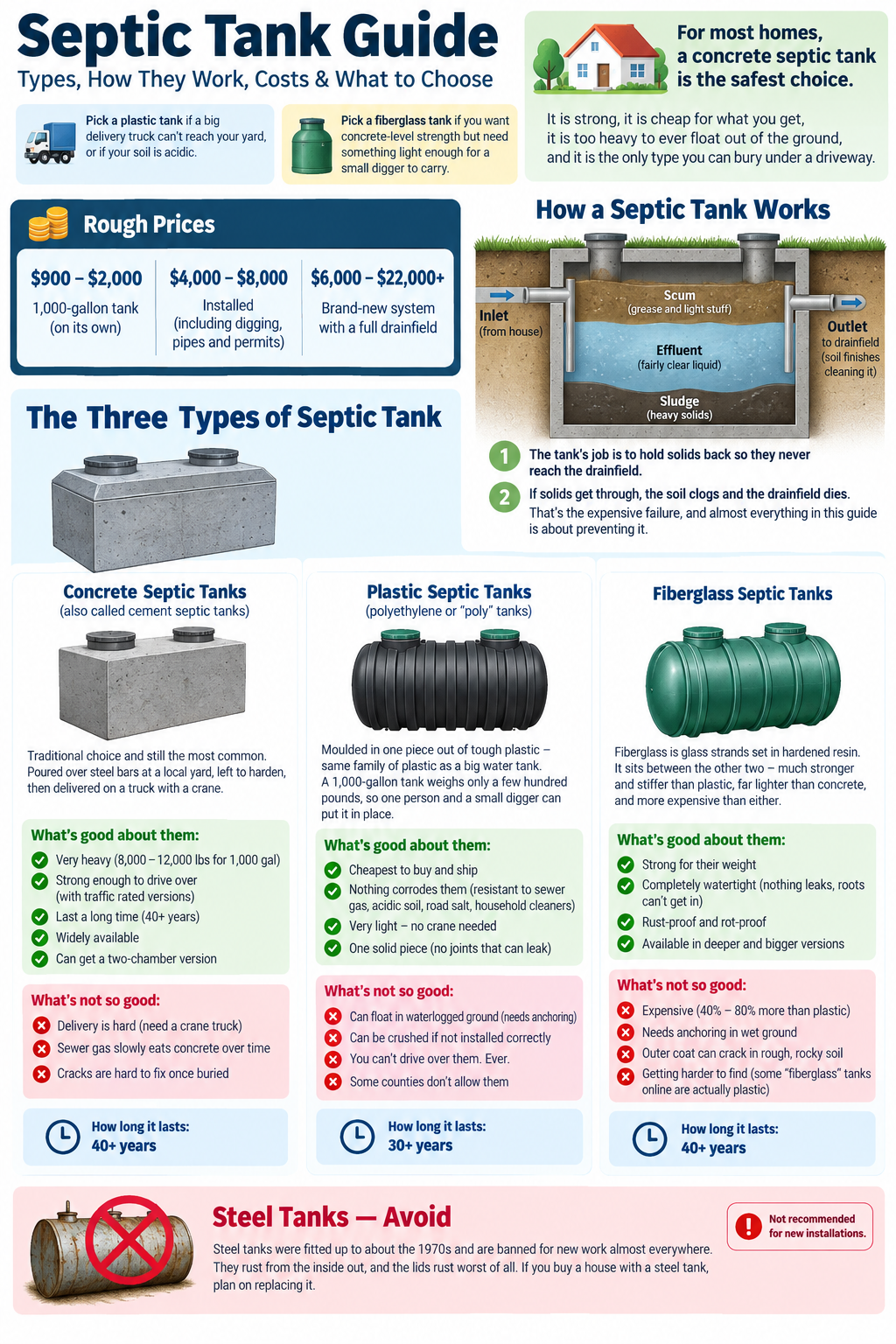
The Three Types of Septic Tank
Concrete Septic Tanks (also called cement septic tanks)
These are the traditional choice and still the most common. They’re poured over steel bars at a local concrete yard, left to harden, then delivered on a truck with a crane.
What’s good about them:
- They’re heavy. A 1,000-gallon concrete tank weighs 8,000 to 12,000 pounds empty. All that weight holds it down, so it can’t be pushed up out of wet ground.
- They’re strong enough to drive over — but only the special “traffic rated” versions. More on that later.
- They last a long time. 40 years or more is normal.
- You can buy one almost anywhere. Nearly every county has a concrete yard nearby, and local inspectors know the product well.
- You can get a two-chamber version, which does a better job of holding solids back.
What’s not so good:
- Delivery is hard. You need a crane truck and a solid path to the hole. That rules them out on steep, narrow or heavily wooded lots.
- Sewer gas slowly eats concrete. Inside the tank, bacteria make a gas that turns into weak acid. Over 20 to 30 years it wears away the concrete near the top and the internal walls.
- Cracks are hard to fix once the tank is buried.
How long it lasts: 40+ years.
Plastic Septic Tanks (polyethylene or “poly” tanks)
These are moulded in one piece out of tough plastic — the same family of plastic as a big water tank. A 1,000-gallon plastic tank weighs only a few hundred pounds, so one person and a small digger can put it in place.
What’s good about them:
- Cheapest to buy and cheapest to ship.
- Nothing corrodes them. Sewer gas, acidic soil, road salt, household cleaners — none of it touches plastic.
- Very light, so no crane, no torn-up yard, and they work on sites where concrete simply can’t go.
- One solid piece, so there are no joints that can leak.
What’s not so good:
- They can float. If your ground gets waterlogged and the tank is empty, it can be pushed up out of the hole. This is fixable — see the anchoring section — but it has to be done at installation.
- They can be crushed. The walls need the right sand or gravel packed around them. Sharp rocks, over-packing, or emptying the tank completely during a wet spell can dent or collapse them.
- You can’t drive over them. Ever.
- Some counties don’t allow them. Check first.
How long it lasts: 30+ years.
Fiberglass Septic Tanks
Fiberglass is glass strands set in hardened resin. Think boat hull. It sits between the other two: much stronger and stiffer than plastic, far lighter than concrete, and more expensive than either. The same material is used for fiberglass sewer tanks and holding tanks.
What’s good about them:
- Strong for their weight. Real rigidity, but still light enough for a small digger.
- Completely watertight. Nothing gets in, nothing leaks out, and roots can’t find a way through.
- Rust-proof and rot-proof, like plastic.
- Available in deeper and bigger versions than plastic tanks go.
What’s not so good:
- Expensive — usually 40% to 80% more than a plastic tank the same size.
- Needs anchoring in wet ground, same as plastic.
- The outer coat can crack if rough, rocky soil is dumped back around it.
- Getting harder to find. Many suppliers switched to plastic. Some tanks sold as “fiberglass” online are actually plastic, so check the spec sheet.
How long it lasts: 40+ years.
Steel Tanks — Avoid
Steel tanks were fitted up to about the 1970s and are banned for new work almost everywhere. They rust from the inside out, and the lids rust worst of all. If you buy a house with a steel tank, plan on replacing it, and never stand on the lid — people have fallen through.
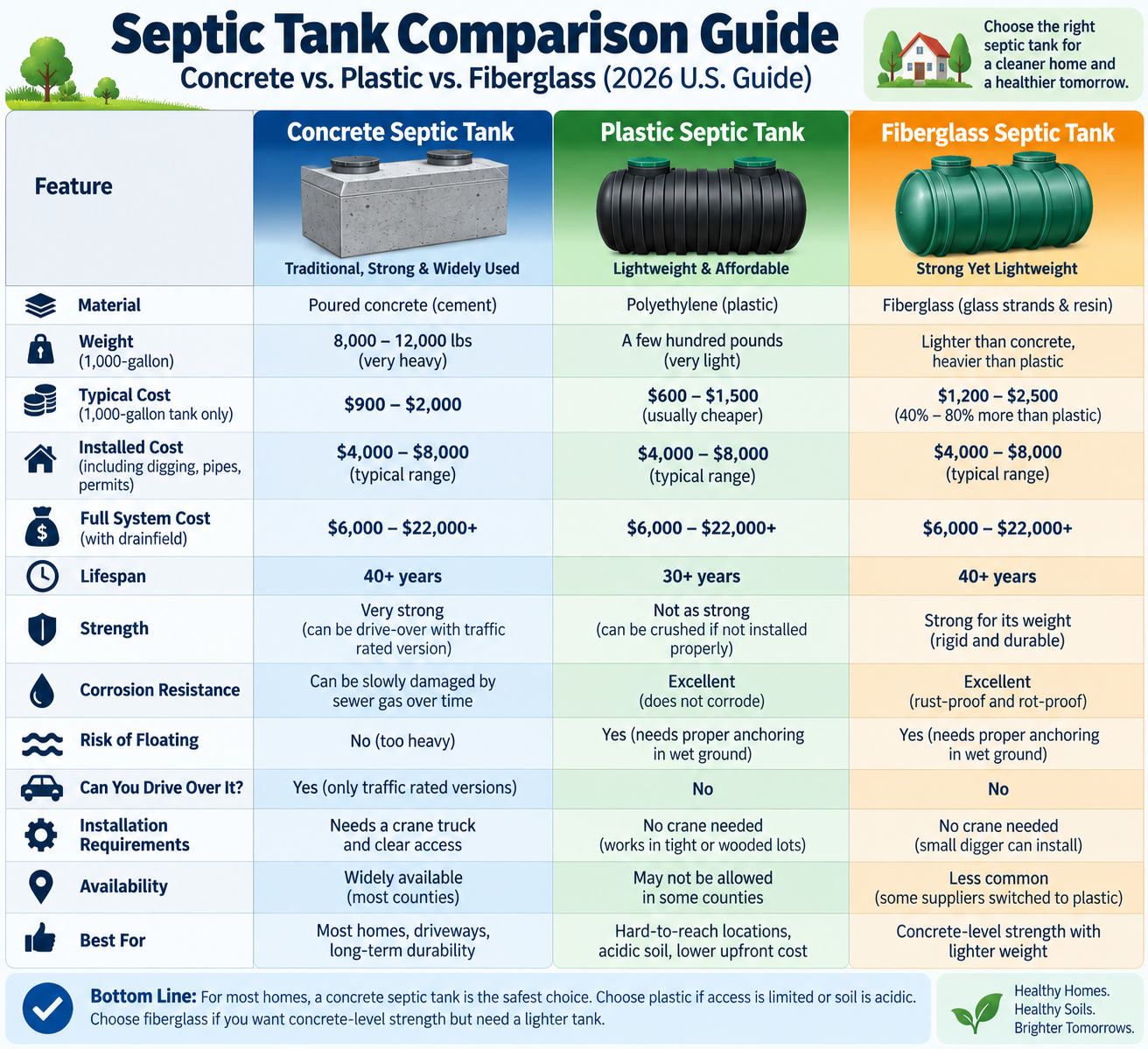
Concrete vs. Plastic vs. Fiberglass, Side by Side
| Concrete | Plastic | Fiberglass | |
| Price (1,000 gallon) | $900–$2,000 | $800–$1,800 | $1,400–$3,000 |
| Weight when empty | 8,000–12,000 lbs | 250–400 lbs | 400–800 lbs |
| Delivery needs | Crane truck | Normal truck | Normal truck |
| Can you drive over it? | Yes, if traffic rated | No | No |
| Damaged by sewer gas? | Slowly, yes | No | No |
| Can it float? | No | Yes, needs anchoring | Yes, needs anchoring |
| Fussy about backfill? | No | Yes | Yes |
| Two-chamber option? | Yes | Yes | Yes |
| Lifespan | 40+ years | 30+ years | 40+ years |
Concrete vs. Plastic
The price gap between them is usually only a few hundred dollars. Next to a job that costs five figures, that’s small. So don’t choose on price alone. Choose on your site.
Go with concrete if: a big truck can reach the hole, your ground gets wet, the tank will sit near a driveway, or your county prefers concrete (many do).
Go with plastic if: access is tight, your lot is steep or wooded, your soil is acidic, or you need to keep the upfront cost down.
The honest verdict: concrete wins on strength and staying put. Plastic wins on price, handling and never corroding. On a normal, easy-to-reach lot, concrete gives you better value over 40 years. On a difficult lot, plastic isn’t a compromise — it’s the right answer. A tank that gets set down properly and levelled beats a stronger tank that got dragged into place and damaged on the way.
Concrete vs. Fiberglass
Fiberglass gives you concrete’s strength without needing a crane. You pay for that twice: once in the tank price, once in the anchors needed to stop it floating. It makes the most sense when you have both poor access and aggressive soil — the one combination concrete handles badly.
Plastic vs. Fiberglass
Both are light, both resist corrosion, both need anchoring. Fiberglass is stiffer and better for deep burial or big sizes. Plastic is cheaper, easier to find, and takes a knock better (it dents where fiberglass cracks). For a normal house at a normal depth, plastic is the better buy. For deep, large or commercial jobs, fiberglass is worth the extra.
What Size Tank Do You Need?
Here’s a rule that surprises people: the size is set by how many bedrooms your house has, not how many people live in it. Councils use bedrooms because the house might be sold to a bigger family later. Most states also insist on a minimum of 750 or 1,000 gallons no matter how small the house is.
| Bedrooms | Water used per day | Tank size you need |
| 1–2 | 200–300 gallons | 750–1,000 gallons |
| 3 | 360–450 gallons | 1,000 gallons |
| 4 | 480–600 gallons | 1,250–1,500 gallons |
| 5–6 | 600–900 gallons | 1,500–2,000 gallons |
| 7+ or multi-family | 900+ gallons | 2,000–3,000+ gallons |
Go one size bigger if you have a garbage disposal (many codes require an extra 250 gallons), a big soaking tub, a home business, regular house guests, or plans to add a bedroom later.
Going bigger at installation costs a little. Replacing a tank that turned out to be too small costs a fortune. This is an easy call.
About small and 500-gallon tanks
A 500-gallon concrete septic tank is too small for a permanent home in most places. It’s for workshops, cabins, hunting camps and holding tanks that get pumped out rather than draining into a field. Always ring the county health department before you buy a small tank — if it doesn’t meet the minimum, you’ll have to dig it back up.
Why a two-chamber tank is worth the extra $100–$300
In a two-compartment concrete septic tank, the first chamber (about two-thirds of the space) does the heavy settling. The second chamber gives the liquid a second chance to drop any remaining bits before it leaves for the drainfield.
Cleaner liquid out means a drainfield that lasts years longer. Many states now require it. Add a small effluent filter in the outlet as well and you’ve got the best drainfield protection money can buy, for a couple of hundred dollars.
Tank Prices by Size
Before you use these numbers: these are national averages for the tank on its own — no digging, no drainfield, no permits. Concrete prices in particular swing a lot by region, because tanks come from a local yard. Expect 20% to 35% higher in the Northeast and on the West Coast, and lower in the Midwest and South. Always get two or three local quotes.
| Size | Concrete | Plastic | Fiberglass | Who it suits |
| 500 gallon | $700–$1,300 | $500–$1,000 | $1,000–$1,700 | Cabins, workshops, holding tanks |
| 750 gallon | $850–$1,500 | $650–$1,300 | $1,200–$2,000 | 1–2 bedroom homes |
| 1,000 gallon | $900–$2,000 | $800–$1,800 | $1,400–$3,000 | 3-bedroom homes — the most common size |
| 1,250 gallon | $1,200–$2,200 | $1,100–$2,000 | $1,800–$3,200 | 4-bedroom homes |
| 1,500 gallon | $1,500–$2,800 | $1,400–$2,400 | $2,200–$3,800 | 4–5 bedroom homes |
| 2,000 gallon | $2,300–$4,000 | $2,000–$3,400 | $3,000–$5,000 | Large homes, duplexes |
| 2,500–3,000 gallon | $3,000–$5,500 | $2,900–$4,500 | $4,000–$7,000 | Multi-family, small commercial |
The 1,000-gallon concrete tank — the number most people want
This is the size that fits a standard three-bedroom house, so it’s what most people are pricing.
- Tank on its own: $900 to $2,000, plus $150 to $500 for delivery if the yard charges separately.
- Fitted, with a working drainfield already there: about $4,000 to $8,000.
- Fitted, with a new drainfield too: $6,000 to $15,000.
1,500 and 2,000-gallon concrete tank prices
A 1,500-gallon concrete tank costs $1,500 to $2,800 for the tank and around $5,500 to $10,000 installed. A 2,000-gallon concrete tank starts around $2,300 and can pass $4,000, with installed costs of $7,000 to $13,000. Bigger tanks need a bigger hole and more work, so the installation cost climbs too.
Fiberglass tank prices
A 500-gallon fiberglass tank is usually $1,000 to $1,700. A 1,000-gallon fiberglass tank is $1,400 to $3,000.
Watch the shipping. Unlike concrete, these come from far away, so freight on a 1,000-gallon tank can be $300 to $900. Also check whether the delivery includes a truck with a tail lift — otherwise you need to unload a very large object yourself.
Handy rules of thumb
- Every extra 100 gallons adds roughly $50 to $150.
- A two-chamber version adds $100 to $300.
- A drive-over (traffic rated) concrete tank adds 30% to 60%.
- Risers, which bring the lids up to ground level, add $300 to $800 — and save you that at the very first pump-out.
- An effluent filter adds $75 to $200 and is the cheapest insurance you’ll ever buy.
What the Full Installation Costs
When people ask what a concrete septic tank costs, they usually mean the whole job. The tank itself is only about 15% to 25% of it. Digging and the drainfield are the big numbers.
| What you’re paying for | Cost | Notes |
| Soil test (perc test) | $700–$2,200 | Needed before anything is designed |
| Drawings and site plan | $500–$1,800 | Often bundled with the soil test |
| Permits and inspections | $450–$2,300 | Varies hugely by county |
| Digging and earthmoving | $1,500–$4,500 | Rock or wet ground pushes this up |
| Tank, delivery and setting | $1,000–$3,500 | Includes the crane for concrete |
| Pipes, fittings, filter, risers | $500–$1,500 | Depends how far the tank is from the house |
| Drainfield | $2,000–$10,000 | Special systems cost far more |
| Tidying up and reseeding | $300–$1,200 | Topsoil, grass, driveway repair |
| Whole new system | $6,000–$22,000+ | Mound or aerobic systems can top $25,000 |
Three realistic situations
| Situation | What’s involved | Total |
| Just replacing the tank | Drainfield is still fine, easy access | $3,500–$7,500 |
| Normal new system | 3-bedroom house, flat lot, soil passes the test | $7,000–$13,000 |
| Difficult site | Poor soil, wet ground or rock, special system needed | $15,000–$30,000+ |
What pushes the price up or down
- Your soil. This is the biggest single factor. If it doesn’t drain well, you need a mound or aerobic system, and the price can double.
- Wet ground or rock. Both mean more hours on a machine.
- Distance from the house. Every extra foot of pipe and depth costs money.
- Access. If a crane truck can’t get in, your choice of tank is made for you.
- Time of year. Quotes are often 10% to 15% cheaper in late autumn than in the spring rush.
- Your county. Permit fees can differ five-fold between neighbouring areas.
How to save money without regretting it
Get three quotes that break out tank, labour, permits and drainfield separately, so you can actually compare them. Let the installer supply the tank — many won’t guarantee a tank you bought yourself. Book outside the busy season. Clear the access route before the crew arrives.
What not to skimp on: tank size, the effluent filter, and risers. Saving there costs you far more later.
What Happens During Installation
The soil test (perc test)
A perc test pours water into a hole and measures how fast it soaks away. That tells the designer whether a normal drainfield will work and how big it has to be.
If you’re buying land, make the sale conditional on the soil passing. A failed test doesn’t always kill a project, but it changes the budget completely.
Permits and distances
Septic work is permitted by your county or state health department. Typical distance rules — check yours locally — are roughly 50 to 100 feet from a well, 5 to 10 feet from the house, 10 feet from the boundary and 25 to 100 feet from a stream or pond.
Most places require an inspector to look at the tank in the open hole. Never let anyone bury a tank that hasn’t been inspected.
What goes around the tank matters
This is where most installations actually go wrong.
Concrete tanks need a flat, firm base. Plastic and fiberglass tanks need a bed of sand or pea gravel and clean soil packed around them a layer at a time — usually filling the tank with water as they go, so the pressure inside matches the pressure outside.
If your ground gets wet, a light tank needs anchoring: concrete blocks buried alongside it (“deadmen”) or a concrete slab underneath with straps over the top. Skipping this is the number one reason tanks pop out of the ground in the first wet spring.
Can you drive over a septic tank?
Only if it’s a traffic rated septic tank. Normal tanks are built to hold up soil, not a car.
There are two ratings you’ll see: H-10 for cars and light vehicles, and H-20 for full-size trucks. In practice that means a reinforced concrete tank with a heavy-duty lid. Plastic and fiberglass tanks are never rated for traffic.
One thing people miss: the lid has to be rated too. A traffic rated tank with an ordinary lid is not a traffic rated system.
Risers and lids
Risers are short collars that bring the tank lids up to ground level, so the tank can be pumped and checked without digging. They cost a few hundred dollars and pay for themselves the first time.
Every lid must be bolted or locked down. An unsecured septic lid is genuinely dangerous — children and pets have fallen into tanks.
Can you do it yourself?
In most states, no. You need a licensed installer, an approved design and inspections. A few rural areas let you install on your own land with an approved plan. Even where it’s legal, the digging, the crane work and the exact slopes are unforgiving, and a DIY system can cause problems when you sell the house.
What Goes Wrong With Each Type
Knowing the warning signs turns a $400 repair into something you catch before it becomes a $12,000 drainfield replacement.
Concrete: the internal walls wear away
Sewer gas turns into weak acid inside the tank and eats at the concrete, especially the internal walls (called baffles) near the outlet. Over 20 to 30 years these can crumble away.
When the outlet baffle goes, floating grease and scum flow straight into the drainfield and clog the soil. This is the most common cause of a drainfield dying early.
Concrete can also crack from ground settling, tree roots or frost.
Signs to look for: bits of solid matter at the outlet, wet patches over the drainfield, the tank filling with sludge faster than it used to.
Fix: replacing a worn baffle with a modern fitting and a filter usually costs $300 to $800. Cheap, if you catch it.
Plastic: the walls can buckle
A plastic tank relies on the liquid inside to balance the soil pressing in from outside. Pump it bone dry during heavy rain or in soggy ground and the walls can cave in.
Rocky or over-packed backfill can also squash the tank during installation, sometimes cracking a pipe fitting.
Signs to look for: the tank looking dented around the lid, pipes being pulled at the inlet or outlet, drains running slow right after a pump-out.
Fiberglass: three problems, all from bad installation
- The outer coat cracks if rough, rocky soil is dumped back around it.
- It floats if it wasn’t anchored. A lifting tank snaps its pipes and opens the whole system up. This is the complaint you’ll read most often about fiberglass.
- It shifts or settles on an uneven base, which throws off the slope and stops things flowing properly.
None of these are faults in fiberglass itself. They all come from treating a light tank like a heavy one. Insist on clean bedding, careful backfilling and proper anchoring, and a fiberglass tank will outlast most concrete ones.
Warning signs for any tank
- A sewage smell indoors or in the yard
- Several drains running slow or gurgling
- A strip of unusually green, lush grass over the tank or drainfield
- Soggy ground or standing water over the drainfield
- Sewage backing up into the lowest drain in the house
If you see any of these, call a septic professional now rather than next month.
Looking After Your Tank
Here’s the thing worth remembering: how you look after the tank matters more than what it’s made of. A well-maintained plastic tank will outlive a neglected concrete one.
How often to pump it out
| Tank size | 1–2 people | 3–4 people | 5–6 people |
| 750 gallons | Every 3–4 years | Every 2 years | Every year |
| 1,000 gallons | Every 5 years | Every 3 years | Every 2 years |
| 1,500 gallons | Every 7–8 years | Every 4–5 years | Every 3 years |
| 2,000 gallons | Every 9–10 years | Every 6 years | Every 4 years |
Pumping costs $300 to $700. If you have a garbage disposal, shorten these intervals by about a third.
Simple rules
- Don’t flush wipes (even the ones labelled flushable), grease, paint, thinners, coffee grounds, cat litter or old medicines.
- Spread out your water use. Six loads of laundry in one day pushes solids straight through the tank and into the drainfield.
- Don’t buy tank additives. Your tank grows the bacteria it needs on its own. Some additives actively cause harm by dissolving solids that then travel out to the drainfield.
- Keep off the drainfield. No cars, no livestock, no sheds, and no deep-rooted trees within about 30 feet.
- Point gutters and runoff away from the drainfield. It can only soak up so much.
- Clean the effluent filter once a year if you have one. It takes five minutes.
Where to Buy and What to Check
Where each type comes from
Concrete tanks come from a local concrete yard, usually within 50 miles, and the yard delivers and sets the tank. They’re too heavy to ship any further economically.
Plastic and fiberglass tanks come from plumbing suppliers, septic suppliers, farm stores and online tank specialists that ship anywhere.
If you’re shopping for fiberglass septic tanks for sale, check three things on the spec sheet before you order: what it’s actually made of (plenty of listings labelled fiberglass are really plastic), how deep it can be buried, and whether your state approves that exact model.
Before you buy anything
- Is it approved in your county? Approved-product lists are local and there’s no arguing with them.
- Is it certified? Look for IAPMO or NSF listing on plastic and fiberglass. For concrete, ask about ASTM C1227.
- How deep can it go? Standard tanks only take so much soil on top.
- What’s the warranty, and does it still apply if you supply the tank yourself?
- How is it delivered? A tail lift or forklift makes a real difference on a rural site.
One warning: many installers won’t guarantee a job using a tank you bought yourself, because they can’t vouch for how it was made or handled. The few hundred dollars you save can cost you a single warranty covering both the tank and the work.
How to Choose
There’s no single “best septic tank” — only the best one for your particular patch of ground. Go down this list. The first line that describes your site is your answer.
| Your situation | Best choice | Why |
| Tank goes under a driveway or parking area | Traffic rated concrete | The only type built to take vehicle weight |
| Ground gets wet or floods | Concrete, or anchored fiberglass | Heavy enough not to float |
| Steep, wooded or hard-to-reach lot | Plastic or fiberglass | Light enough for small machines |
| Acidic or aggressive soil | Plastic or fiberglass | Nothing corrodes them |
| Deep burial or large size needed | Fiberglass or concrete | Stiff enough to take the pressure |
| Tightest possible budget | Plastic | Cheapest to buy and ship |
| Normal, easy-access lot with average soil | Concrete | Best long-term value |
If you want one recommendation: a two-chamber concrete tank, sized for your bedroom count, with an effluent filter and risers up to ground level. Longest track record, accepted everywhere, and the cheapest cost per year over its life — as long as a truck can reach the hole.
Common Questions
How much is a concrete septic tank?
About $700 for a 500-gallon tank up to $4,000 for a 2,000-gallon one. The common 1,000-gallon size is $900 to $2,000. Fitted, expect $4,000 to $8,000 to swap a tank, or $7,000 to $13,000 for a complete new system.
How much does a 1,000-gallon concrete septic tank cost?
$900 to $2,000 for the tank, plus $150 to $500 delivery. Fully installed, with a working drainfield already there, $4,000 to $8,000.
Which is better, plastic or concrete?
Neither is better everywhere. Concrete wins on an easy-access lot, in wet ground, or near a driveway. Plastic wins on tight sites, acidic soil and tight budgets. Your site decides.
Do plastic septic tanks really float?
Yes, if they aren’t anchored. An empty light tank in waterlogged ground can be pushed up out of the hole and snap its pipes. Concrete anchors or a slab underneath prevent it completely, and any good installer will include them where needed.
How long does a septic tank last?
Concrete and fiberglass, 40+ years. Plastic, 30+ years. But the drainfield usually gives out first, at 20 to 30 years — sooner if the tank isn’t pumped on schedule.
What size tank do I need for a 3-bedroom house?
1,000 gallons in most places. Go bigger if you have a garbage disposal or might add a bedroom.
Can I park on my septic tank?
Only if it’s a traffic rated tank with matching traffic rated lids, and only where your county allows it. Driving over an ordinary tank can collapse the lid, and people have been killed that way.
What’s a two-compartment tank and do I need one?
It’s a tank split into two chambers so the liquid gets settled twice before it leaves. Cleaner liquid means a longer-lasting drainfield. Many states now require it, and it only adds $100 to $300.
What problems do fiberglass septic tanks have?
Floating when not anchored, cracking in the outer coat from rocky backfill, and shifting on an uneven base. All three come from how it was installed, not from the material.
Can a cracked tank be repaired?
Small cracks in concrete can sometimes be patched if the tank is dug out and still sound. Fiberglass can be patched with resin. Big cracks, crumbled internal walls or a squashed tank mean replacement.
How often should I pump my septic tank?
Every 3 to 5 years for a family of four on a 1,000-gallon tank. Bigger tank or fewer people, less often. Garbage disposal, more often.
Are steel septic tanks still allowed?
Not for new installations in most places. If you’ve got one, treat it as due for replacement, and never walk on the lid.
Does a septic tank affect selling my house?
A working system with paperwork is fine. A failing one can stop a sale or a mortgage. Most buyers and many lenders want a septic inspection and a recent pump-out receipt. Keep your receipts and the original permit — they’re worth real money when you sell.
Can I install a septic tank myself?
In most states, no. You need a licensed installer, an approved design and inspections.
Can I use a concrete septic tank to hold water or keep fish?
No. A septic tank is built for wastewater and is never suitable for drinking water or fish. Bare concrete leaches lime into water and pushes the pH right up, which kills fish. Concrete tanks meant for animals, fish or drinking water have to be properly cured and sealed with a coating certified safe for that use. And never reuse an old septic tank for anything holding water for people or animals.